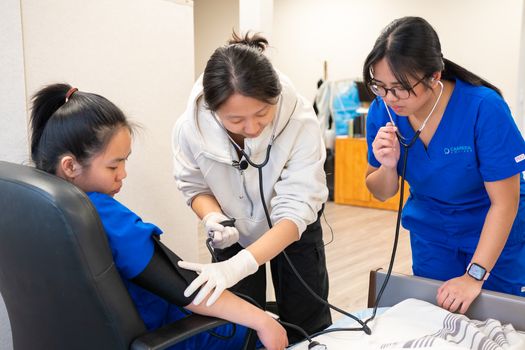
A patient who seemed comfortable an hour ago is suddenly restless, breathing faster, and answering questions slowly. The monitor may not be sounding an alarm, but an observant nurse notices that something has changed. Knowing what to assess, how to respond, and how to communicate the concern can make a critical difference.
This example shows why nursing skills involve much more than completing procedures. Nurses combine clinical knowledge, careful observation, communication, compassion, organization, and sound judgment. These abilities help them recognize risks, coordinate care, support recovery, and make patients feel safe during stressful experiences.
What Are the Most Important Nursing Skills?
The exact skills a nurse needs depend on education, licensure, experience, specialty, state law, and workplace policy. A home health nurse may use different equipment from an intensive care nurse, but both need a strong foundation in assessment, safety, communication, documentation, patient education, and ethical care.
Essential nursing skills generally fall into three connected areas:
- Clinical abilities used to assess patients and provide treatments safely
- Communication skills for working with patients, families, and healthcare teams
- Patient-care skills that protect comfort, dignity, independence, and well-being
These areas cannot be separated completely. For example, administering medication requires technical accuracy, communication with the patient, awareness of symptoms, and monitoring for the intended effect or an adverse reaction.
Clinical Abilities Nurses Use Every Day
Patient assessment and observation
A nursing assessment gathers information about a patient’s physical condition, symptoms, mental status, functional ability, medical history, medications, and concerns. Depending on the setting, this may include measuring vital signs, listening to heart and lung sounds, examining the skin, evaluating pain, checking mobility, and reviewing fluid intake and output.
Strong nurses do more than collect numbers. They compare current findings with earlier results, identify patterns, and consider what is normal for the individual patient. A small change in alertness, urine output, breathing, skin color, or behavior may be important even when a single measurement appears acceptable.
Clinical judgment and prioritization
Nurses frequently care for several people with competing needs. Prioritization helps them decide which problem requires immediate attention and which task can safely wait. Threats involving the airway, breathing, circulation, sudden neurological changes, severe allergic reactions, or rapid deterioration generally require urgent assessment and escalation.
Clinical judgment also includes knowing when information is incomplete. A safe nurse pauses, checks the record, reassesses the patient, or contacts an appropriate team member rather than making an unsupported assumption.
Medication and treatment safety
Medication administration requires concentration and a consistent verification process. Nurses follow applicable policies to confirm the patient’s identity, medication, dose, route, timing, allergies, clinical indication, and required monitoring. They must also document administration accurately and watch for therapeutic effects, side effects, or signs of an adverse reaction.
Technical treatments may include wound care, specimen collection, catheter care, intravenous therapy, oxygen administration, and management of feeding tubes or drains. Not every nurse performs every procedure. Competency must be established through appropriate education, supervised practice, and workplace authorization.
Infection prevention
Hand hygiene, correct use of personal protective equipment, safe handling of sharps, aseptic technique, and proper cleaning of equipment reduce the risk of spreading infection. Gloves do not replace hand hygiene, and hands should be cleaned at appropriate points before, during, and after patient care. The CDC guidance on clinical hand hygiene explains when healthcare workers should use alcohol-based hand sanitizer and when soap and water are needed.
Communication Is a Patient-Safety Skill
Listening and explaining clearly
Patients may be frightened, uncomfortable, tired, or overwhelmed by unfamiliar terminology. Nurses need to listen without rushing, ask focused questions, and explain information in plain language. Tone, facial expression, eye contact, and body posture can affect whether a patient feels respected and comfortable speaking honestly.
Teach-back is a useful way to check understanding. Instead of asking, “Do you understand?” the nurse invites the patient to explain the instructions in their own words. This can reveal confusion about medications, wound care, warning signs, follow-up appointments, or activity restrictions. Teach-back evaluates the clarity of the explanation rather than testing the patient.
Team communication and handoffs
During handoffs and urgent updates, information should be concise, organized, and clinically relevant. Structured methods such as SBAR, which stands for Situation, Background, Assessment, and Recommendation, can help team members communicate concerns in a predictable format.
Closed-loop communication adds another safeguard. The receiver repeats an important instruction, and the sender confirms that it was understood correctly. Nurses must also be willing to speak up when an order is unclear, a patient’s condition changes, or a planned action may create a safety risk.
Respectful and inclusive care
Effective communication accounts for language, hearing, vision, health literacy, culture, and cognitive ability. Qualified interpreters should be used when needed, particularly for consent, medication instructions, discharge planning, and other significant discussions. Nurses should avoid assumptions and ask patients how they prefer to receive information or involve family members.
Patient Care Goes Beyond Medical Tasks
Patients often remember how a nurse treated them as clearly as they remember the treatment itself. Preserving privacy, responding to discomfort, explaining what will happen next, and involving patients in decisions are fundamental parts of care.
Practical patient-care responsibilities may include:
- Helping with bathing, toileting, eating, positioning, and mobility
- Assessing pain and evaluating the response to interventions
- Reducing fall, pressure-injury, aspiration, and infection risks
- Supporting sleep, nutrition, hydration, and emotional comfort
- Protecting confidentiality and maintaining professional boundaries
- Advocating for patient preferences, safety, and access to appropriate services
Good care encourages independence whenever possible. Rather than automatically completing every task for a patient, a nurse evaluates what the person can do safely and provides the right amount of assistance. This can support confidence, mobility, and preparation for returning home.
Documentation, Delegation, and Time Management
Clear documentation creates a record of assessments, interventions, patient responses, education, and communication with other professionals. Entries should be timely, objective, accurate, and consistent with legal requirements and organizational policy. Nurses should record observable facts rather than vague judgments or personal opinions.
Delegation is another important skill, but it does not simply mean assigning unwanted work. The nurse must consider the patient’s condition, the task, the team member’s training, applicable scope-of-practice rules, and the level of supervision required. After delegating, the nurse remains responsible for appropriate follow-up and evaluation within the requirements of the role.
Time management supports all these responsibilities. Effective nurses organize care while remaining flexible enough to respond when priorities change. Checklists, bedside planning, purposeful rounding, and grouping compatible tasks can improve efficiency without sacrificing attention to the patient.
How Future Nurses Can Build These Skills
Nursing competence develops gradually through science courses, skills laboratories, simulation, supervised clinical experiences, feedback, and repeated practice. Students preparing for a program can begin by strengthening anatomy, physiology, microbiology, mathematics, study habits, and communication. Completing the right coursework, including options for preparing for nursing prerequisites online, can create a stronger academic foundation before clinical training begins.
Successful nurses remain willing to ask questions and continue learning throughout their careers. They review current policies, practice unfamiliar procedures under supervision, reflect on mistakes and near misses, and seek feedback from experienced colleagues. Confidence is valuable, but safe practice also requires humility and awareness of personal limits.
Ultimately, the best nursing skills bring knowledge and compassion together. Technical ability helps deliver treatment correctly, communication keeps everyone informed, and person-centered care ensures that the patient is never reduced to a diagnosis or task list.