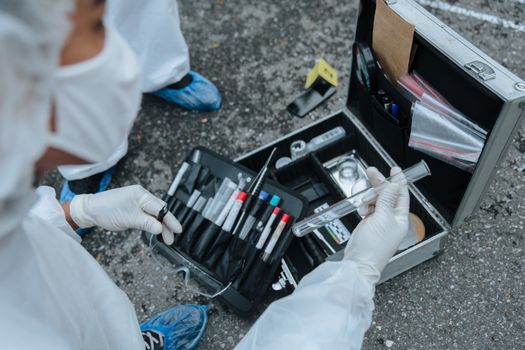
You may picture a criminalist arriving at a crime scene, spotting one tiny clue, and solving the case before lunch. The real job is less theatrical and far more methodical. Criminalists are laboratory-focused forensic professionals who examine physical evidence, document their methods, interpret results, and explain what those results can and cannot establish. Their work may influence charging decisions, court proceedings, and whether evidence supports or challenges an investigative theory.
What Does a Criminalist Do?
A criminalist applies chemistry, biology, physics, statistics, and established laboratory procedures to evidence connected with legal investigations. Depending on the laboratory and specialty, that evidence might include suspected drugs, biological material, fibers, glass, paint, firearms-related evidence, fire debris, or other trace materials.
The title is sometimes used interchangeably with forensic scientist or forensic science technician. Employers define these positions differently, so applicants should compare duties rather than relying on the job title alone. A criminalist is also different from a criminologist, who generally studies crime, criminal behavior, and social systems. Criminalists usually analyze physical evidence.
Common responsibilities include:
- Receiving, labeling, preserving, and tracking evidence
- Performing chemical, biological, microscopic, or instrumental examinations
- Following validated methods and laboratory quality procedures
- Recording observations, calculations, controls, and test results
- Reviewing data and drawing scientifically supportable conclusions
- Writing technical reports for investigators, attorneys, and courts
- Providing expert testimony when called as a witness
- Participating in proficiency testing and continuing education
Some criminalists also visit crime scenes, but many spend most of their time in secure laboratories. Crime scene collection and laboratory analysis may be handled by separate employees, particularly in larger agencies.
Education Needed to Become a Criminalist
A bachelor’s degree is the typical starting point. Useful majors include forensic science, chemistry, biochemistry, biology, molecular biology, or another laboratory-based natural science. A criminal justice degree by itself may not contain enough chemistry, biology, mathematics, and laboratory coursework for scientific positions.
Students should review actual job announcements before selecting courses. Requirements often depend on the assignment. A controlled-substance position may emphasize analytical chemistry, while DNA work may require coursework in genetics, molecular biology, biochemistry, and statistics. Firearms, trace evidence, toxicology, and digital evidence positions have their own preferred backgrounds.
A master’s degree is not required for every entry-level job, but it can be useful for specialized work, research, technical leadership, teaching, or advancement. Students comparing this profession with other criminal justice career opportunities should remember that criminalistics is primarily a science career within the justice system.
Choosing a College Program
A degree labeled “forensic science” is not automatically the best choice. Look closely at the curriculum, laboratory facilities, faculty experience, internship opportunities, and graduate outcomes. A strong program should provide substantial hands-on science education rather than relying mainly on survey courses about crime and investigation.
Programmatic accreditation can be another quality indicator, although many capable scientists graduate from programs that do not hold specialized forensic accreditation. Regardless of the major, students benefit from organic and analytical chemistry, biology, physics, calculus or statistics, technical writing, ethics, and laboratory quality assurance.
Training After Hiring
A college degree does not usually qualify a new criminalist to begin independent casework immediately. Laboratories provide structured training in the employee’s assigned discipline. This may involve reading procedures, observing experienced analysts, practicing examinations with known samples, learning instruments, completing mock cases, and passing written and practical assessments.
The employee must also learn evidence security, chain-of-custody rules, contamination prevention, report writing, safety procedures, and courtroom testimony. Training length varies by employer and specialty. Complex disciplines may require many months or longer before an analyst is authorized to issue reports independently.
Competency testing normally occurs before independent casework. After authorization, criminalists may undergo periodic proficiency testing, case reviews, testimony monitoring, and continuing education. These safeguards help laboratories identify training needs and demonstrate that analysts remain capable of performing assigned work.
Are Certification or Licensing Required?
There is no single national license that every U.S. criminalist must hold. Requirements vary by jurisdiction, laboratory, position, and forensic discipline. Some employers require specific coursework or internal authorization rather than professional certification. Others may prefer or eventually expect certification from a recognized forensic credentialing organization.
Certification is generally a voluntary professional credential showing that an analyst has met stated education, experience, examination, ethics, and continuing-education standards. It should not be confused with laboratory accreditation. Certification evaluates an individual, while accreditation assesses whether a laboratory or academic program meets applicable standards.
Credentials may be available in areas such as forensic DNA, biological evidence screening, drug analysis, and foundational criminalistics knowledge. Because eligibility rules and examinations can change, candidates should check the current requirements for their intended specialty. Certification may support advancement, but it does not replace a relevant science degree, employer training, or demonstrated competency.
Typical Employers
Most criminalists work for public agencies. City, county, and state crime laboratories analyze evidence for police departments, sheriff’s offices, prosecutors, medical examiner or coroner systems, and other government organizations. Some large police agencies operate their own laboratories, while regional or statewide facilities serve multiple jurisdictions.
The broader federal category of forensic science technicians is concentrated heavily in state and local government, according to the U.S. Bureau of Labor Statistics career profile for forensic science technicians. Other potential employers include federal law enforcement laboratories, independent testing laboratories, universities, research organizations, consulting firms, and companies that develop forensic instruments or laboratory services.
Private-sector opportunities exist but are less common than government positions. Private laboratories may perform testing for public agencies, defense attorneys, insurers, corporations, or other clients. Experienced criminalists may also become quality managers, laboratory supervisors, trainers, consultants, or college instructors.
What Employers Look for Beyond a Degree
Accuracy and scientific judgment matter more than dramatic investigative instincts. Criminalists must be willing to follow detailed procedures, question unexpected results, disclose limitations, and document every important step. A small recordkeeping error can create uncertainty about evidence handling or laboratory conclusions.
Strong candidates typically demonstrate:
- Careful laboratory technique and attention to detail
- Clear technical writing and verbal communication
- Knowledge of statistics and scientific uncertainty
- Objectivity and a commitment to ethical conduct
- The ability to work independently and accept peer review
- Comfort explaining complex science to nonscientists
- Professionalism under questioning in court
Government hiring may also involve a background investigation, drug screening, review of academic transcripts, and questions about an applicant’s ability to handle confidential or disturbing evidence. Requirements vary, so candidates should read each announcement carefully.
Is a Criminalist Career a Good Fit?
This career may suit someone who enjoys laboratory science, precise documentation, problem-solving, and public service. It can be rewarding to know that careful analysis may help identify a substance, connect evidence to a source, exclude an innocent person, or clarify disputed facts.
However, much of the work is repetitive, highly regulated, and performed under deadlines. Criminalists may face heavy caseloads, extensive quality reviews, courtroom scrutiny, and exposure to unpleasant case details. Success requires patience and the ability to remain neutral. The criminalist’s role is not to prove a suspect guilty; it is to examine evidence fairly and communicate conclusions supported by the science.
For students interested in this path, the most practical first steps are to build a strong natural-science foundation, gain laboratory experience, study job postings in the desired specialty, and seek internships when available. Careful preparation can make the transition from college laboratory courses to professional forensic casework much smoother.