You may find one job posting offering about $45,000 and another advertising six figures for what appears to be the same cardiovascular tech role. The difference is not necessarily an error. Cardiovascular technology includes several specialties, and pay can change substantially based on training, credentials, workplace, location, schedule, and experience.
For a useful national benchmark, the median cardiovascular tech salary was $74,310 per year, or $35.73 per hour, in May 2025. The lowest-paid 10% earned less than $39,000, while the highest-paid 10% earned more than $121,350. These figures describe cardiovascular technologists and technicians as a group, so they should be viewed as a starting point rather than a guaranteed offer.
What does a cardiovascular tech earn?
The median salary of $74,310 means half of workers earned more and half earned less. It is not the same as an average, and it does not represent a standard starting wage. Someone entering the field as an electrocardiogram technician may earn closer to the lower end, while an experienced invasive cardiovascular specialist who takes call may earn considerably more.
The U.S. Bureau of Labor Statistics cardiovascular career profile reports the following May 2025 median salaries by major workplace:
- Outpatient care centers: $95,080
- Medical and diagnostic laboratories: $81,200
- Physicians’ offices: $76,850
- Hospitals: $69,970
These numbers do not mean every outpatient center pays more than every hospital. Hospital employees may receive overtime, on-call compensation, shift differentials, or stronger benefit packages that increase total compensation. Local staffing shortages and the complexity of the position also affect an employer’s offer.
What work is included in this salary category?
Cardiovascular technologists and technicians conduct diagnostic tests and assist with procedures involving the heart, circulation, and, in some positions, the lungs. They may prepare patients, operate medical equipment, monitor vital signs, check test quality, identify possible abnormalities, and provide findings to physicians.
Common job paths include:
- Cardiographic or EKG technicians, who perform electrocardiograms, stress tests, and ambulatory monitoring
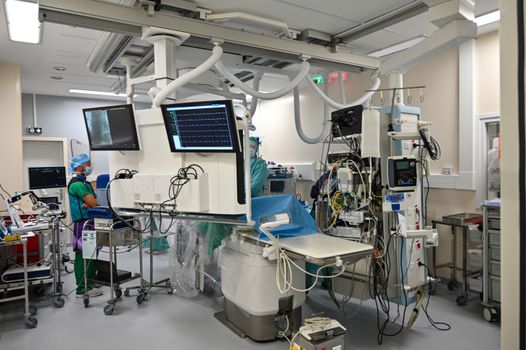
- Cardiac catheterization technologists, who assist with invasive procedures such as catheterization and stent placement
- Electrophysiology specialists, who support procedures related to heart rhythm disorders
- Cardiac sonographers, who produce ultrasound images of the heart
- Vascular technologists, who evaluate blood flow and blood vessels
Job titles can be confusing. Federal wage data for cardiovascular technologists and technicians do not include all diagnostic medical sonographers, even though employers may casually call an echocardiographer a cardiovascular tech. When comparing salaries, confirm the specialty, required credentials, and actual duties rather than relying on the title alone.
What factors raise a cardiovascular tech salary?
Specialized clinical skills
Roles involving cardiac catheterization, electrophysiology, complex imaging, or emergency procedures may pay more because they require advanced technical abilities and greater responsibility. Cross-training in several areas can also make a worker more valuable, particularly in smaller hospitals that need flexible staff members.
Professional credentials
Employers may require or prefer credentials that match the position. Examples include Certified Cardiographic Technician for EKG-related work and Registered Cardiovascular Invasive Specialist for cardiac catheterization. Cardiac sonography, vascular, and electrophysiology positions have their own credentials.
Certification does not automatically produce a raise. However, it can help a candidate meet hiring requirements, qualify for specialized work, or make a stronger case during salary negotiations. Workers should check job advertisements in their area before choosing a certification.
Experience and leadership duties
Entry-level workers generally earn less while they build speed, technical judgment, and confidence with patients. Income may rise after several years, especially for employees who train new staff, manage equipment, coordinate a laboratory, supervise a team, or participate in quality-improvement work.
Work setting and location
Wages vary across states and metropolitan areas. Regions with higher living costs or shortages of trained professionals may offer larger salaries, but housing, transportation, taxes, and childcare can reduce the practical value of that increase.
Work setting matters as well. Outpatient centers may offer higher base pay or predictable hours, while hospitals may provide more opportunities for overtime and advanced procedures. Compare the entire offer rather than focusing only on the annual number.
Evening, weekend, and on-call work
Healthcare facilities operate around the clock, and emergency cardiac care cannot always wait until morning. Some cardiovascular technologists work nights, weekends, holidays, or rotating on-call schedules. Shift differentials, callback pay, overtime, and standby compensation can meaningfully increase annual earnings, although they may also affect sleep, family time, and work-life balance.
What benefits may come with the job?
A cardiovascular tech salary is only one part of compensation. Depending on the employer and whether the position is full time, benefits may include:
- Medical, dental, and vision insurance
- Paid vacation, sick leave, and holidays
- A retirement plan, employer match, or pension
- Life and disability insurance
- Tuition assistance or student-loan support
- Certification, examination, and renewal reimbursement
- Continuing-education funding
- Uniform, parking, or commuting assistance
- On-call, overtime, and shift-differential pay
A lower base salary can sometimes be the better offer if it includes affordable health coverage, generous paid leave, retirement contributions, and a manageable schedule. Ask for a written benefits summary before accepting a job.
How much education is needed?
Cardiovascular technologists and technicians typically need a postsecondary certificate or associate degree, although requirements depend on the specialty. Some entry-level EKG positions may accept a high school diploma followed by employer training. More advanced invasive and imaging roles commonly require formal coursework and supervised clinical experience.
Relevant programs usually cover anatomy, physiology, medical terminology, patient care, equipment operation, and applied science. Students comparing healthcare technology with other technical fields can also explore how early educational experiences build career skills through this overview of the Illinois Tech precollege experience.
Before enrolling, check whether the program provides appropriate clinical training and prepares graduates for the credential employers request. State requirements and facility policies can differ, and some positions also require CPR or basic life support certification.
How to evaluate a job offer
Convert the offer into total annual compensation. For an hourly position, multiply the hourly rate by expected weekly hours and working weeks, then add predictable differentials or on-call pay. Review insurance costs, retirement contributions, paid leave, and education assistance separately.
Also ask how often raises occur, whether certification earns a pay adjustment, how call is scheduled, and whether orientation hours are guaranteed. A realistic cardiovascular tech salary comparison should account for both money and quality of life. The best-paying position on paper may not be the best choice if it requires an unsustainable commute or frequent overnight call.
Overall, the field offers a broad income range, with a national median above $74,000 and opportunities to move higher through specialization, experience, credentials, flexible scheduling, and carefully chosen workplaces. Understanding exactly what each role requires is the key to comparing offers accurately and planning a path toward stronger earnings.