
You may be ready to start a healthcare career but unable to spend several years in school. That naturally raises the question: how long for phlebotomy training? For many beginners, the answer is about four weeks to four months, although some programs last a full semester or up to one year. Your schedule, clinical requirements, state rules, and certification plans determine the actual timeline.
Completing a class is also not always the same as being ready to work. You may need supervised blood draws, a certification exam, a background check, or state approval before beginning a job. Understanding each step can help you choose a program that is both efficient and accepted by employers.
How Long Is a Phlebotomy Class?
A short, full-time phlebotomy class may finish its classroom portion within four to eight weeks. Part-time and evening programs commonly take two to four months, while college programs may run for one semester or longer. According to the U.S. Bureau of Labor Statistics overview of phlebotomy education, postsecondary phlebotomy programs usually take less than one year to complete.
Program length generally falls into one of these ranges:
- Accelerated course: Approximately four to eight weeks, often with frequent weekday classes
- Part-time or evening course: Approximately two to four months
- Semester-based college program: Approximately four to six months
- Extended certificate program: Up to one year, especially when it includes additional laboratory or healthcare coursework
- Employer training: Varies according to the employer, job duties, and the trainee’s previous experience
Do not evaluate a program by calendar length alone. A four-week course may require several hours of class and practice almost every day. A three-month course may teach similar material at a slower pace that works better for students with jobs or family responsibilities.
What Happens During Training?
Phlebotomy involves more than learning how to place a needle into a vein. Blood samples must be collected, labeled, handled, and transported correctly. Mistakes can affect test results, delay care, or require a patient to have blood drawn again.
Coursework commonly covers:
- Basic anatomy and physiology of the circulatory system
- Venipuncture and capillary or skin-puncture techniques
- Patient identification and preparation
- Infection prevention and exposure control
- Needle, tube, and collection-equipment selection
- Specimen labeling, processing, storage, and transport
- Medical terminology and laboratory procedures
- Communication with anxious, fainting, pediatric, or older patients
- Professional conduct, privacy, and workplace safety
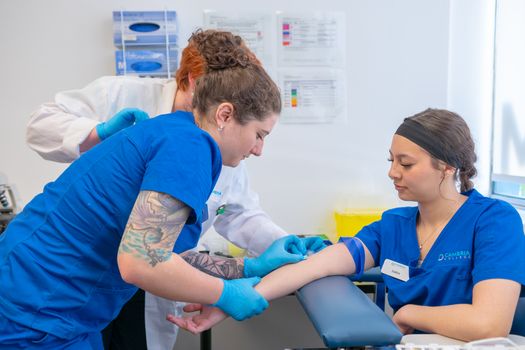
Students usually practice first with training equipment before performing supervised collections. Clinical training may take place in a laboratory, hospital, clinic, blood center, or another approved setting. The required number of supervised hours and successful collections depends on the program, credentialing organization, and state.
How Clinical Training Affects the Timeline
The classroom portion may have a fixed end date, but clinical placement is often the most unpredictable part of the schedule. A school must locate an appropriate site, coordinate supervision, and give students enough opportunities to demonstrate their skills.
Clinical training can take longer if the facility sees relatively few patients or if several students are competing for available procedures. Absences may also delay completion because students must satisfy attendance, competency, or blood-collection requirements.
Before enrolling, ask whether clinical training is included in the advertised program length. Some schools include it in an eight- or twelve-week schedule, while others arrange the clinical experience only after classroom instruction is complete.
How Long Does Certification Take?
After completing an eligible training route, you may be able to apply for a national certification examination. Certification requirements vary by organization. They may include a high school diploma or equivalent, formal classroom instruction, documented clinical experience, successful blood collections, and a passing examination score.
A reasonable planning estimate is several additional weeks after graduation. You may need time to:
- Receive your completion documents or transcript
- Collect proof of clinical training and successful procedures
- Submit an examination application
- Wait for eligibility approval
- Schedule and take the exam
- Receive or verify your credential
Exam availability and application processing times can change, so check the current rules of your chosen credentialing organization before selecting a training program. Preparing documents before graduation may prevent avoidable delays.
Training Certificates, Certification, and State Approval
These terms sound similar but are not interchangeable. A training certificate shows that you completed a school’s course. Professional certification is a credential awarded by a certifying organization, typically after you meet eligibility requirements and pass an exam. State certification, licensing, or registration is government authorization that may be required where you intend to work.
Many states do not require a separate phlebotomy license, but employers may still prefer or require national certification. Other states establish specific education, examination, clinical, or application requirements. Always check with the relevant state agency before paying tuition, particularly if you may move after graduation.
What Can Delay Your Start Date?
The course itself may be short, but admission and employment requirements can add time. Depending on the school or clinical site, you may need immunization records, tuberculosis screening, CPR or Basic Life Support training, a physical examination, a drug screening, or a criminal background check.
Common causes of delay include:
- Waiting for the next class to begin
- Limited clinical placement availability
- Missing health or academic records
- Incomplete certification paperwork
- Needing additional practice to demonstrate competency
- State application or approval processing
If you are comparing career pathways, learning what a work-training program can offer may help you decide whether a classroom-based course, employer-sponsored route, or combined approach fits your needs.
How to Choose the Right Program Length
The fastest course is not automatically the best choice. Look for a program that provides sufficient hands-on instruction and prepares you for the credential or state authorization you want. Ask schools for written answers about total tuition, clinical placement, completion requirements, certification eligibility, and the typical time from enrollment to graduation.
Questions to ask before enrolling
- Does the advertised length include clinical training?
- Who arranges the clinical placement?
- How many classroom and hands-on hours are included?
- Does the program meet my state’s current requirements?
- Which certification exams will I be eligible to take?
- What happens if I need more time to complete the required procedures?
- Are evening, weekend, or part-time schedules available?
A Realistic Start-to-Work Timeline
For many students, a realistic start-to-work estimate is approximately two to six months. That may include admission preparation, classroom instruction, supervised practice, an optional or required certification exam, and job onboarding. An accelerated student with readily available clinical training may finish sooner. A part-time student or someone waiting for state approval may need longer.
In short, how long is a phlebotomy class? The instruction may last only a few weeks, but the complete path to employment often takes several months. Confirming clinical, certification, and state requirements before enrolling is the best way to avoid surprises and choose a timeline that supports safe, confident patient care.

