Remember when you could post a job, get 50 applicants, and pick the one with the fanciest resume? Those days are fading fast.
Between retiring Boomers and a widening skill gap, many industries are running dry on qualified candidates. Clients don’t want to hear that you’re struggling to fill the role because you’re dipping your hand into a dwindling pool and coming up short every time.
What they want is action, results, and fast. Fortunately, fast-track degrees and accelerated education pathways have stepped in as real solutions.
If you’ve been pushing paper or scanning resumes forever, it’s time to think differently.
Boomers Out, Empty Seats In
Baby Boomers are retiring in droves. According to Investopedia, the U.S. needs about 4.6 million new workers annually to keep the labor supply steady. The problem is that younger generations aren’t keeping pace.
Skills Are Out of Sync
The World Economic Forum’s Future of Jobs Report 2025 warns that 39% of core skills will be disrupted by 2030. Technology, sustainability, and healthcare are leading the shift. The result? Most workers aren’t retraining fast enough to match employers’ needs.
Some states now have fewer than 40 workers available for every 100 open jobs, claims the U.S. Chamber of Commerce. Sectors such as healthcare and manufacturing are hit hardest.
Manufacturing Today reports that U.S. factories face an acute talent shortage, threatening innovation and output. Without a fresh pipeline of skilled workers, supply chains risk further bottlenecks. Things are quite similar in many other industry verticals.
The Rise of Fast-Track Degrees
So what’s the antidote? Fast-track and accelerated education pathways are shorter, skill-focused programs designed to plug gaps quickly.
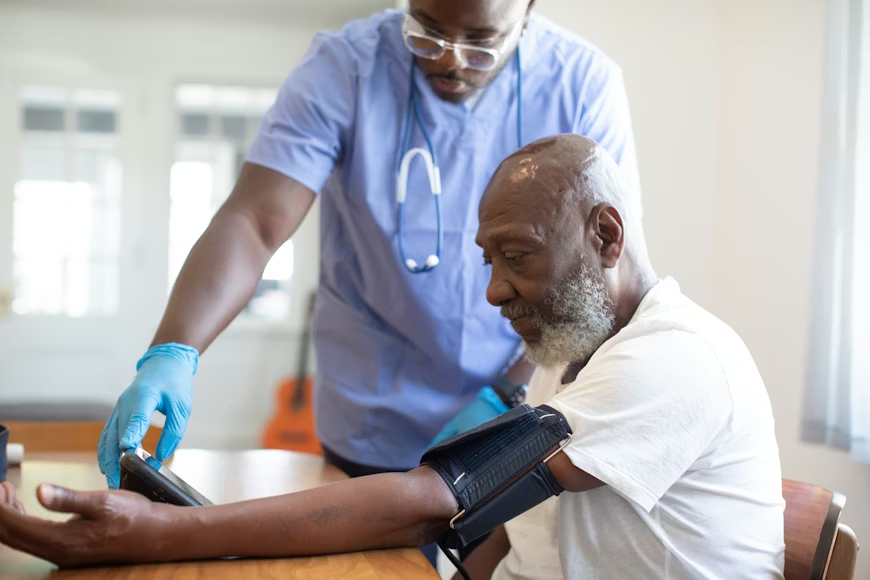
Nurses on the Double
Many places of higher learning offer accelerated BSN online programs. The Accelerated Bachelor of Science in Nursing (ABSN) is one of the most popular due to its 100% online format.
Students with a bachelor’s degree in another field can become registered nurses (RNs) in record time. The accelerated BSN program can be completed in four semesters, full-time. This is critical at a moment when hospitals are short-staffed and patients can’t wait.
Early Childhood Educators in Months, Not Years
In North Carolina, child care academies are training early childhood educators through streamlined programs. The method helps fill desperate staffing shortages in daycare and preschool. These professionals play a key role in the early development of children. Additionally, they prepare young learners for further education by providing them with a solid foundation.
School Counselors
Schools do not require educators alone. Specialized roles like school counselors are required to address the holistic development needs of students. While there is a shortage in this area, online school counseling master’s programs are addressing the gaps.
Walsh University highlights that the course requires 60 credit hours of coursework, in addition to 100 practicum hours and 600 internship hours. Being an online program, it is easy to complete for working professionals.
Skills Training with ROI
Fast-track skills programs aren’t only a quick fix; they’re a smart investment. Accelerated training solutions assist organizations in closing urgent gaps while maximizing skills budgets.
For learners, the benefit is an early entry into the workforce. This is a great opportunity for both career-beginners and professionals seeking a change of job or industry. The head start saves time and keeps their income steady even during a transition.
Why HR Recruiters Should Care
HR recruiters have plenty of good reasons to care about fast-track degrees. The faster a role is filled, the less money is lost. Fast-track graduates are job-ready sooner, which means shorter time-to-hire cycles for recruiters.
A workplace report argues that adopting a skills-based hiring approach is essential. Recruiters who look past rigid degree requirements open doors to diverse, highly motivated talent pools.
Forbes explains that accelerated degrees don’t churn out graduates; they strategically align education with workforce needs, reducing the “waiting period” between studying and earning.
Oh, and McKinsey makes an interesting point. The global management firm believes that empowering the workforce through reskilling programs and public-private partnerships could be the most powerful tool. That means HR recruiters who tap into these initiatives gain an edge.
How Recruiters Can Encourage Fast-Track Pathways
Rewrite Job Descriptions
Include language that welcomes accelerated credentials. Instead of saying “4 years required,” try: “Traditional or accelerated degree paths accepted.”
Build Partnerships
Work with universities and training academies to establish direct hiring pipelines. Many universities provide accelerated programs in an online mode. These eliminate the need to join college and make learners career-ready without long hours of study.
Embrace Skills-Based Screening
Stop filtering out candidates because they don’t fit the “perfect resume mold.” Test for competencies instead. It widens your pool and supports diversity in your team.
Incentivize Internal Reskilling
Internal reskilling is a smart move because it empowers your team with members who already know your company and its culture. They won’t have to be trained from the ground up, and can blend in seamlessly even in new roles. Offer tuition reimbursement for employees pursuing fast-track or online programs. With the right support, your existing team can pivot into sought-after roles.
Tell the Success Stories
Help kill the stigma about learning without investing years in a traditional degree. Fast-track means smart, accelerated, and responsive. Showcase hires who took these pathways and thrived.
A Long-Term Solution
Workforce shortages aren’t a temporary blip. As Boomers retire and industries transform, HR recruiters can’t rely on the same old playbook.
By embracing fast-track degrees and accelerated programs, you’ll not only fill roles faster but also future-proof your organization.
Think of it as fueling careers, industries, and communities. That’s the kind of impact you want to make during a hiring crisis.
Encourage candidates to continue learning and feed their minds with the relevant brain food. It makes your job so much easier by bringing in the right people with the corresponding degrees. That’s your contribution to a better-functioning workplace.