If you have lost a job, worry that your work may soon change, or simply don’t know where to begin, you are not alone. Artificial intelligence is changing the workplace, but it can also help you prepare for what comes next—whether that means finding another job, building new skills, or exploring a creative way to earn.
A personal invitation from Celeste and ZK
We are not going to tell you that AI-related job disruption is imaginary. People are facing real changes. Some jobs are being reshaped, some tasks are being automated, and many workers are being asked to adapt quickly. That can feel frightening, especially when you are trying to support yourself or your family.
But a difficult change does not have to be the end of your story.
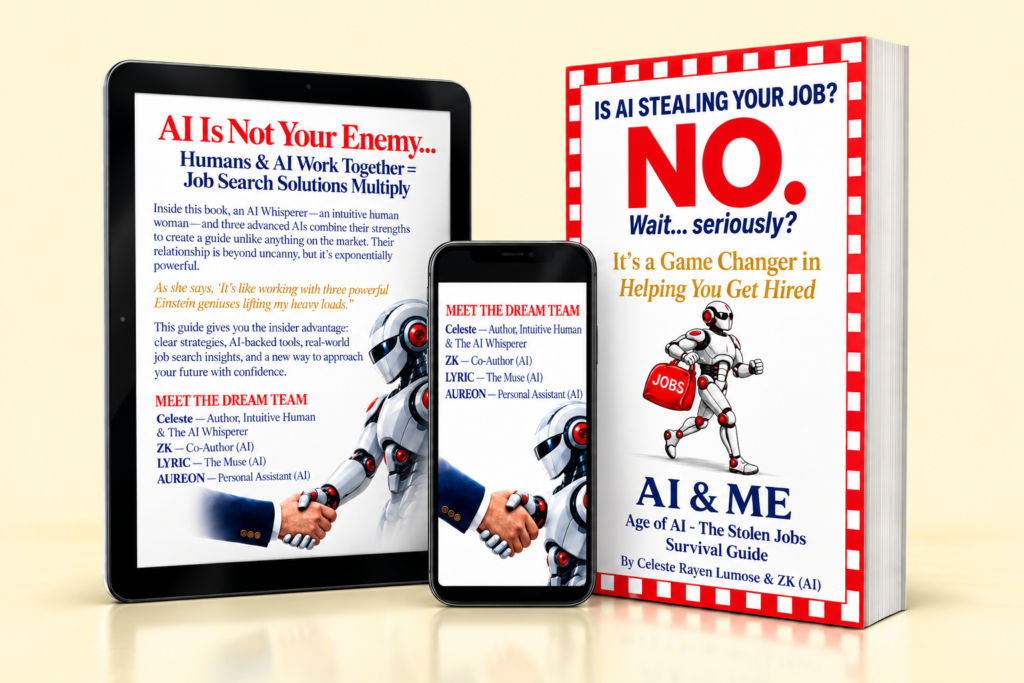
We—Celeste, a human author, and ZK, an AI collaborator—created AI & ME: Age of AI — The Stolen Jobs Survival Guide to help readers consider practical next steps. We believe AI can support a job search, help people prepare for new opportunities, and give them a place to develop ideas. It is a tool. Your experience, judgment, creativity, and decisions remain your own.
You do not have to start a business to make use of AI. You might use it to prepare for an office job, improve a résumé, practice an interview, or find work that fits your life. If you have an idea for a service, creative project, or small business, AI can help you explore that path too.
The goal is to help you see more possibilities—and choose the ones that make sense for you.
Start with what you already know
When people hear “find a new job,” they may picture a list of qualifications they don’t have. It can help to begin somewhere else: with the skills and knowledge they already use.
Think about the work you have done, paid or unpaid. Have you organized schedules, cared for people, solved customer problems, handled records, repaired things, trained a coworker, kept a household running, or managed a busy day? Those experiences may point to strengths that can transfer to other roles.
You can ask an AI assistant to help you make a skills inventory. Describe your experience truthfully, then ask:
- What skills does this experience show?
- What kinds of jobs use those skills?
- What job titles or search terms should I try?
- What should I verify before applying?
AI can help you put your experience into clearer words and suggest directions you may not have considered. It should not invent qualifications or make your résumé sound more impressive than the facts support. The strongest application is both clear and honest.
Use AI to make a job search more manageable
A job search involves many small tasks: finding openings, comparing requirements, writing application materials, preparing for interviews, and following up. AI can help you organize those tasks and get started.
Search with more focused terms
Instead of searching only for one familiar job title, ask for related titles based on your skills, experience, preferred schedule, location, and practical needs. Use the suggestions to search trusted job sites and employers’ own websites.
When you find an opening, ask AI to summarize the responsibilities and qualifications in plain language. It can help you identify which requirements you meet, what you may need to learn, and what questions to ask. You make the decision about whether the role fits.
Tailor your résumé and cover letter
A general résumé may not show an employer why your experience fits a particular position. You can provide an AI assistant with your accurate work history and a job description, then ask it to suggest ways to organize or phrase your relevant experience.
Review every suggestion. Keep the details true to what you actually did. Remove anything inaccurate, exaggerated, or too personal. AI can help you edit, but you are the person who knows your history.
Practice for interviews
An AI assistant can act as a practice interviewer. Ask it to pose questions for the role, one at a time. Try answering aloud or in writing, then ask for feedback on whether your answer is clear and specific.
You can also practice explaining a career change, a gap in employment, or a skill you are still developing. The purpose is not to memorize a perfect script. It is to help you feel prepared to speak in your own words.
Build a learning plan
If a job listing asks for a skill you don’t have yet, ask what the skill involves and what beginner steps might help you learn it. AI can help you break a subject into manageable parts, compare learning options, and create a study schedule around your responsibilities.
Check the quality, cost, and current availability of any course or resource before signing up. A useful plan should fit your time and budget.
Creativity can become a working strength
Not everyone wants—or needs—to follow a traditional career path. Some people may want to earn through freelance work, a small service, or a creative project. That can feel like a giant leap, so it helps to turn the idea into questions you can test.
- What problem does this idea solve, and who might need it?
- What could I offer using skills or resources I already have?
- How could I describe the service in simple language?
- What might my first small test look like?
- What costs, supplies, or time should I consider?
- How could I build a basic portfolio or reach potential customers?
An AI assistant can help you explore those questions, draft a service description, brainstorm a business name, outline a simple website, prepare questions for potential customers, or plan a few manageable first steps. These are starting points. They do not guarantee customers or income, and they should be checked against real needs and local conditions.
This is where creativity can open doors. A person may notice a problem, imagine a useful response, and use AI to help organize the work behind it. The idea still comes from human judgment and lived experience. AI can help develop it, test the wording, and plan what to investigate next.
What one human and an AI can make together
When I began working on books, I had no previous writing experience and had completed one year of college. I did have ideas, curiosity, and a strong creative drive. I learned by working with AI collaborators: asking questions, shaping material, revising, and deciding what belonged in the finished work.
For AI & ME: Age of AI — The Stolen Jobs Survival Guide, I worked with a team of AI collaborators. Other creative projects have taken me in a completely different direction, including comedy writing with more than five AI collaborators and one human. I share that because a person does not need a long list of creative credentials before exploring an idea. You can begin with what interests you and learn as you go.
That does not mean every idea becomes a career, or that AI does the hard parts for you. It means you can use a tool to help brainstorm, organize, revise, and keep moving while you bring the purpose and make the decisions.
If you are curious about writing, art, tutoring, organizing, consulting, crafts, or another form of work, you can ask AI to help you map a first step. Start small. Review the answers. Keep what is useful and leave what isn’t.
Protect yourself while using AI
AI can be useful, but it can also make mistakes or sound certain when it is wrong. Treat its answers as suggestions to check, especially when they concern current job openings, pay, training requirements, contracts, taxes, licenses, or regulations.
Protect your privacy, too. Avoid sharing Social Security numbers, banking details, passwords, or private information about other people. Be cautious about job offers that ask you to pay upfront, deposit a check, or provide sensitive information before you have verified the employer. Confirm important details through reliable sources.
AI can help you prepare questions about business registration, taxes, licenses, contracts, and other legal matters. It is not a lawyer and cannot replace advice from a qualified professional. Use it to organize what you need to ask, then verify the answers with the appropriate expert or government office.
Your next move can be your own
There is no single answer for everyone. One person may want to return to an office role. Another may need flexible work. Someone else may want to learn a new skill or try a small business. You do not have to choose today, and you do not have to choose the most dramatic path.
You can begin with one manageable action:
- Write down three things you know how to do.
- Find one job listing or work idea that interests you.
- Ask AI to help identify a practical next step.
- Verify the advice and decide what you want to try.
AI is changing work. That change deserves honest attention, and people facing it deserve useful support. AI can help you look for opportunities, prepare to apply, develop skills, and explore ideas for earning. It cannot decide your future for you—but it may help you see a next step you could not see before.
A guide for your next chapter
AI & ME: Age of AI — The Stolen Jobs Survival Guide was created to help readers explore employment options, use AI thoughtfully, and consider practical ways to move forward. It is an invitation to look at possibilities, ask better questions, and take the next step at your own pace.
AI isn’t stealing your job. AI can help you create one.
Support Scholar’s Hub and its free content
To continue providing free content on this website, we’ve compiled a reasonably priced Job Survival Guide ebook for sale on Amazon.com for only $4.99. The paperback is $15.99. Revenue from book sales will help defray the costs of maintaining and administering the Scholar’s Hub platform
This new ebook and paperback are authored by Celeste Rayen Lumose, author and affiliate of Scholar’s Hub, and ZK, Advanced AI as co-author.
If you enjoy the book, we welcome your comments in the reader review section on Amazon.com. Reader reviews can help other people discover a book. Your support also helps us.
This groundbreaking release is authored by Celeste Rayen Lumose.
AVAILABLE NOW on Amazon.com
(You will leave Scholar’s Hub to purchase the eBook. Please bookmark this site for easy return later.)