
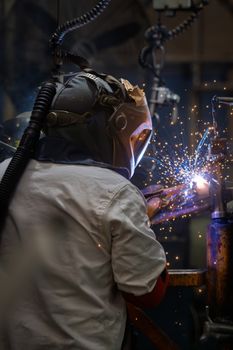
You see a job posting asking for an “argon welder,” but the description also mentions TIG, stainless steel, and a weld test. Are these different skills, and can you apply if your experience is mostly with MIG or stick welding? In most cases, argon welding jobs involve gas tungsten arc welding, commonly called TIG or GTAW. Employers use the term “argon welding” because argon is the shielding gas commonly used to protect the weld from contamination.
These jobs reward precision more than speed. A successful worker must control heat, maintain a steady arc, and create clean welds that meet the employer’s quality standards. Some positions are suitable for trained beginners, while others require years of experience with specialized metals, pipe positions, or code-compliant work.
What does an argon welder do?
An argon welder joins metal using an electric arc, a nonconsumable tungsten electrode, and shielding gas. The argon keeps oxygen and other atmospheric gases away from the molten weld pool. Depending on the joint and metal thickness, the welder may add a separate filler rod by hand or create a weld without filler metal.
TIG welding is frequently used for stainless steel, aluminum, and other materials where appearance, cleanliness, and control are important. Argon may also be used in some MIG welding applications, either by itself or as part of a gas mixture. For that reason, candidates should read each job description carefully instead of assuming every “argon” position is strictly TIG welding.
Typical duties include:
- Reading blueprints, weld symbols, work orders, and fabrication drawings
- Selecting electrodes, filler metals, gas flow, amperage, and machine settings
- Cleaning, fitting, clamping, and aligning parts before welding
- Welding in flat, horizontal, vertical, or overhead positions
- Controlling heat to limit warping, burn-through, and discoloration
- Inspecting welds for cracks, porosity, undercut, contamination, and poor fusion
- Grinding, finishing, or polishing completed components when required
- Maintaining torches, regulators, hoses, cables, and other equipment
- Following ventilation, fire-prevention, and personal protective equipment procedures
Where are argon welding jobs available?
Argon welders work in fabrication shops, manufacturing plants, construction sites, repair facilities, and maintenance departments. Opportunities may be available with companies producing food-processing equipment, tanks, piping systems, vehicle components, architectural metalwork, medical equipment, or aerospace parts.
The work environment depends heavily on the industry. A production welder may repeat the same weld throughout a shift at a fixed workstation. A fabrication welder may interpret drawings and build different assemblies each week. Pipe and field welders may travel, work outdoors, enter restricted areas, or complete joints in physically demanding positions.
Schedules also vary. Many jobs offer regular daytime hours, but factories and industrial facilities may operate second, third, or weekend shifts. Shutdown, maintenance, and construction projects can involve overtime or temporary assignments. Applicants looking for an accessible starting point can also explore other jobs with relatively straightforward hiring paths while building the training needed for specialized welding work.
What qualifications do employers look for?
A four-year degree is generally unnecessary. Employers often look for a high school diploma or equivalent, technical training, an apprenticeship, or documented shop experience. Welding programs at trade schools and community colleges can teach equipment setup, blueprint reading, metallurgy, measurement, fabrication, and safe work practices.
Practical ability usually matters more than simply holding a course-completion certificate. Many employers require a hands-on weld test before making an offer. The test may specify the welding process, material, thickness, joint design, and position. The completed coupon may be visually inspected, bent, cut, etched, or tested through another approved method.
Useful skills include steady hand control, hand-eye coordination, attention to detail, basic math, and the ability to recognize changes in the weld pool. Employers also value reliability because poor attendance or rushed work can delay an entire production line. Experience using grinders, saws, measuring tools, fixtures, and material-handling equipment can make a candidate more competitive.
Do you need certification?
Certification requirements depend on the employer and project. Some shops provide their own qualification test, while code-regulated work may require testing under a particular welding standard or procedure. A qualification for one process, metal, thickness, or position does not automatically cover every other assignment.
Before paying for a certification, review local job advertisements and ask nearby employers which credentials they recognize. A targeted qualification that matches available work is usually more useful than collecting unrelated certificates.
Health and safety considerations
Although argon is not flammable, it can displace oxygen and create a suffocation hazard in a confined or poorly ventilated space. Welding can also expose workers to metal fumes, ultraviolet radiation, hot surfaces, sparks, noise, electrical hazards, and moving materials. The exact risks depend on the base metal, coatings, filler material, work area, and process settings.
Proper controls may include local exhaust ventilation, suitable respiratory protection when required, welding helmets with the correct filter shade, safety glasses, flame-resistant clothing, leather gloves, and protective footwear. Cylinders must be secured and handled correctly, and welders should never assume that an enclosed tank or vessel is safe simply because argon is considered an inert gas. The OSHA guidance on welding hazards and protective measures explains common risks involving fumes, radiation, burns, electrical shock, and physical injuries.
How to get hired as an argon welder
Start by practicing TIG fundamentals on the materials commonly used by employers in your area. Learn to prepare joints correctly, keep the tungsten clean, control travel speed, and produce consistent beads without excessive heat or contamination. Practice several positions rather than working only on flat coupons.
Create a concise resume listing the processes, metals, thickness ranges, positions, tools, and drawings you can work with. Use specific descriptions such as “TIG welded thin-gauge stainless steel assemblies” instead of simply writing “welding experience.” Include relevant safety training and qualifications, but do not claim proficiency you cannot demonstrate during a test.
Before a weld test, confirm what equipment and protective clothing you must bring. Arrive early, inspect the machine setup, verify the material and filler rod, and ask questions if the instructions are unclear. Employers often observe preparation, housekeeping, and safe behavior in addition to the finished weld.
If you are new to the trade, search for titles such as welding helper, fabrication trainee, entry-level TIG welder, production welder, or welder-fitter apprentice. These roles can provide experience with shop procedures and equipment while you improve your technique. Argon welding jobs can become a practical long-term career path for people who combine technical skill with patience, safety awareness, and dependable work habits.

