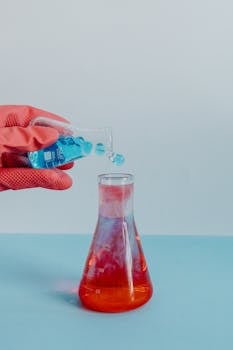
Chemistry experiments for kids provide an exciting way to engage young minds and spark curiosity about the natural world. Whether you’re a parent, teacher, or an enthusiastic learner yourself, bringing chemistry alive through hands-on activities can make learning both fun and educational. These experiments not only foster a love for science but also develop critical thinking and problem-solving skills in children.
Exciting Chemistry Experiments for Kids
Exploring chemistry through experiments helps demystify concepts and makes science accessible. Here are some simple yet captivating experiments you can try with your children.
1. Baking Soda and Vinegar Volcano
Create a volcanic eruption using household items. This classic experiment demonstrates an acid-base reaction.
- Ingredients: Baking soda, vinegar, food coloring (optional), a small container.
- Instructions: Fill the container with baking soda, add a few drops of food coloring, and pour vinegar slowly to witness the eruption.
This experiment is both safe and visually entertaining, illustrating the reaction between an acid (vinegar) and a base (baking soda) that produces carbon dioxide gas.
2. Magic Milk Experiment
Learn about surface tension with this colorful milk experiment.
- Ingredients: Milk, food coloring, dish soap, a shallow dish.
- Instructions: Pour milk into the dish, add drops of food coloring, and then a drop of dish soap to see the colors dance.
This experiment shows how soap disrupts the surface tension of the milk, causing the colors to mix and move.
3. Rainbow in a Jar
Create a liquid rainbow by layering different colored liquids based on their density.
- Ingredients: Honey, light corn syrup, dish soap, water with food coloring, and vegetable oil.
- Instructions: Carefully layer each liquid in a jar, starting with the densest (honey) at the bottom and working upwards to the vegetable oil.
This experiment teaches children about density and the properties of different liquids.
4. DIY Lava Lamp
Create a mesmerizing lava lamp using water, oil, and a fizzy tablet.
- Ingredients: A clear bottle, water, vegetable oil, food coloring, and effervescent tablets.
- Instructions: Fill the bottle with water and oil, add food coloring, then drop in an effervescent tablet to see the “lava” effect.
Children learn about the immiscibility of oil and water and the reaction that causes effervescence.
The Science Behind These Experiments
Each of these chemistry experiments for kids is designed to illustrate fundamental scientific principles in a fun and engaging way.
Enhancing STEM Education
Activities like these support STEM education by encouraging children to question, explore, and understand scientific concepts. A hands-on approach can ignite a passion for the sciences that may lead to future academic and career pursuits in science, technology, engineering, and mathematics.
Safety First
While these experiments are safe, always ensure that children are supervised by an adult. Encourage them to wear protective eyewear when appropriate, and keep a clean workspace to prevent any accidents.
For further guidance and tips on integrating educational activities into daily life, check out our article on starting fresh with new career paths.
Additional resources on educational experiments and STEM can improve the learning experience. The Education page on Wikipedia offers further reading on educational methodologies and approaches.
By introducing children to these chemistry experiments for kids, you’re not only teaching them science; you’re encouraging curiosity and lifelong learning.
- Chemistry experiments can spark interest in science.
- Safe, supervised experiments teach scientific concepts.
- Hands-on activities enhance STEM learning.
- Simple household items can create engaging experiments.
- Encourage inquiry and exploration through science.
What age group are these experiments suitable for?
These experiments are generally suitable for children aged 5 and up, with appropriate adult supervision.
Can these experiments be modified for older children?
Yes, you can introduce more complex scientific explanations or expand on the experiments to challenge older children.
What should I do if an experiment goes wrong?
Ensure safety first; if any mishap occurs, clean up promptly and discuss what might have happened as a learning opportunity.
How do these experiments benefit children?
They enhance problem-solving skills, encourage scientific thinking, and make learning enjoyable.
Where can I find more information on STEM education?
Visit educational resources online or bookstores for books dedicated to STEM education activities.