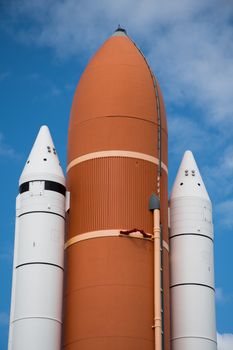
You watch a rocket rise from the launchpad, but for the first few seconds it may look surprisingly slow. Then it clears the tower, accelerates rapidly and disappears from view. So, how fast does rocket travel during a real mission? There is no single speed: a rocket starts at zero, may exceed the speed of sound within minutes, and must reach roughly 17,500 miles per hour to place a spacecraft into low Earth orbit.
That orbital figure is about 28,000 kilometers per hour, or 7.8 kilometers per second. At that speed, an object could theoretically cross the continental United States in several minutes. A rocket does not maintain one constant speed, however. Its velocity changes with altitude, mission destination, engine performance, remaining fuel and flight stage.
How fast does a rocket travel after launch?
At liftoff, the rocket is moving at zero miles per hour. Its engines must first produce enough thrust to overcome the vehicle’s weight. Once thrust is greater than the downward force of gravity, the rocket begins climbing and accelerating.
The early ascent is deliberately controlled. Flying too fast through dense lower-atmosphere air would create excessive aerodynamic pressure, vibration and heating. Launch teams therefore design a trajectory that balances speed with structural safety. The rocket may briefly reduce engine power near “max Q,” the point of maximum aerodynamic stress, before increasing power again as the surrounding air becomes thinner.
A typical orbital launch progresses through several broad speed ranges:
- At the launchpad: 0 mph.
- During lower-atmosphere ascent: hundreds to several thousand mph.
- After leaving the thickest atmosphere: several thousand to more than 10,000 mph.
- Near low Earth orbit: approximately 17,500 mph.
- During departure toward the Moon or deep space: often more than 20,000 mph relative to Earth.
These are general ranges rather than a schedule followed by every rocket. A small suborbital vehicle, for example, may enter space but never approach orbital speed. A large launch vehicle carrying a lunar spacecraft needs substantially more energy.
Reaching space is not the same as reaching orbit
A common misconception is that a rocket enters orbit as soon as it reaches space. Altitude alone is not enough. A vehicle can climb above the atmosphere and still fall back to Earth if it lacks sufficient sideways velocity.
Orbit is essentially continuous free fall. The spacecraft moves sideways so quickly that, as gravity pulls it downward, Earth’s curved surface falls away beneath it. In low Earth orbit, the required speed is generally close to 17,500 mph, although the exact figure depends on altitude and the shape of the orbit.
This is why rockets gradually tilt after rising from the pad. The initial climb helps them pass through the dense atmosphere, while the long, curving portion of the flight builds horizontal speed. NASA’s explanation of how a rocket flies from launch to orbit shows how powered ascent, staging and upper-stage burns work together.
Why rockets use multiple stages
Most of a launch vehicle’s mass at liftoff consists of propellant, tanks and engines. Empty tanks and burned-out engines become dead weight. Carrying them all the way to orbit would require even more fuel, adding still more weight.
Staging solves this problem. A multistage rocket is built as two or more connected vehicles. When the first stage uses its propellant, it separates. The next stage then accelerates a much lighter vehicle.
First stage
The first stage provides the enormous thrust needed to lift the complete rocket and push it through the lower atmosphere. It carries the heaviest load and often has the largest engines. Depending on the design, the stage may fall into a designated area, be recovered at sea or fly back for a controlled landing.
Upper stages
Upper stages operate at higher altitudes, where atmospheric drag is much lower. Their job is usually to add the horizontal velocity needed for orbit, adjust the orbit or send the payload toward another destination. They may produce less thrust than the first stage but can operate efficiently for longer burns.
Dropping empty stages does not create speed by itself. Instead, it improves efficiency by allowing the remaining engines to accelerate less mass. It is similar to removing a heavy backpack before running uphill.
Orbital speed, escape velocity and mission speed
Orbital speed is often confused with escape velocity. Near Earth’s surface, escape velocity is about 25,000 mph, or 11.2 kilometers per second. This is the speed an unpowered object would theoretically need to escape Earth’s gravitational influence without receiving additional propulsion.
Real spacecraft do not normally accelerate instantly to escape velocity at the launchpad. They gain speed through a series of engine burns, often enter a temporary parking orbit and then perform another burn toward the Moon or another planet. Their paths are carefully calculated to use fuel efficiently and take advantage of the motion and gravity of celestial bodies.
A spacecraft’s reported speed also depends on the reference point. It may have one speed relative to Earth, another relative to the Sun and another relative to its destination. Therefore, claims about the “fastest rocket” can be misleading unless they identify what was moving, where it was in the mission and what reference frame was used.
Why speed changes after the engines stop
A rocket does not need to keep its engines firing to remain in orbit. Once it has the correct altitude and sideways velocity, it can coast. With almost no atmospheric drag, a spacecraft retains its motion while Earth’s gravity continually bends its path.
Speed can still change during coasting. A spacecraft in an elliptical orbit moves faster when it is closer to Earth and slower when it is farther away. Engine burns can raise or lower an orbit, while gravity assists near planets or moons can alter speed and direction without requiring an equally large amount of propellant.
What rocket speed means for passengers and payloads
People and equipment inside a spacecraft do not simply feel the final speed. They feel acceleration: the rate at which speed or direction changes. A smooth ride at 17,500 mph can feel less dramatic than a rapid acceleration at a much lower speed. Engineers must manage acceleration, vibration, noise and changing gravitational forces so astronauts, satellites and scientific instruments survive launch.
Rocket flight also depends on thousands of people working in engineering, mission planning, weather monitoring, communications and transportation. Readers interested in the wider employment world around moving people and equipment may find this guide to getting started with travel occupations helpful.
The short answer
How fast does rocket travel? It begins at zero, accelerates through thousands of miles per hour and generally needs about 17,500 mph to achieve low Earth orbit. Missions beyond Earth may exceed 20,000 mph relative to the planet, while the precise speed changes throughout the journey.
The key is not simply going upward as fast as possible. A successful rocket must gain altitude, build enormous sideways velocity, discard unnecessary mass and arrive at exactly the right speed and direction for its intended orbit or destination.