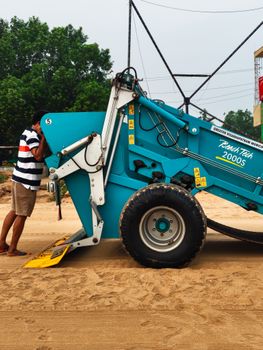
You may have watched an excavator operator shape a trench with surprising precision and wondered, “How do I get paid to do that?” The good news is that you usually do not need a four-year degree. The challenge is proving that you can operate powerful machinery safely, follow site instructions and work productively around other people.
Learning how to become a heavy equipment operator starts with choosing an entry route that fits your time, budget and career goals. Some beginners train directly with an employer, while others attend trade school or enter a paid apprenticeship. The fastest route is often an entry-level construction job that provides supervised equipment training, but formal instruction may make you a stronger candidate and give you experience on more than one type of machine.
What Does a Heavy Equipment Operator Do?
Heavy equipment operators control machinery used to move earth, lift materials, grade surfaces and prepare construction sites. Common machines include excavators, bulldozers, backhoes, wheel loaders, graders, skid steers, rollers and forklifts. Crane operation is generally treated as a specialized area with additional federal, state or local requirements.
The job involves more than moving controls. Operators inspect equipment, check fluid levels, identify mechanical problems, read grade stakes or site plans, communicate with ground crews and perform basic maintenance. Work may take place on roads, residential developments, mines, farms, industrial sites or large infrastructure projects.
Basic Requirements for Getting Started
Most employers expect applicants to be at least 18 years old and have a high school diploma or equivalent. You also need the physical ability to climb into equipment, sit for extended periods and remain alert in noisy or uncomfortable conditions. A valid driver’s license and reliable transportation are commonly important because construction sites may change frequently.
Employers may also require a pre-employment drug test, background check or driving-record review. Requirements differ by company, project and location, so check actual job postings before paying for training.
The Fastest Routes Into the Career
Start as a Laborer or Equipment Trainee
Applying for construction laborer, yard worker, equipment helper or operator-trainee positions can be the quickest and least expensive route. You may begin by handling materials, cleaning machines, serving as a spotter or operating compact equipment under supervision. Reliable workers may gradually move into skid steers, rollers, loaders and larger machines.
This option lets you earn money while learning, but advancement depends heavily on the employer. Ask whether the company has a structured training process and whether trainees receive documented evaluations for each machine.
Attend a Trade or Vocational School
Heavy equipment programs may combine classroom lessons, simulators and supervised practice. Training commonly covers machine controls, inspections, excavation, grading, safety procedures and basic maintenance. Some programs also introduce laser levels, GPS grading systems or blueprint reading.
Before enrolling, ask how many hours of actual seat time are included. Find out which machines you will operate, whether the school helps with job placement and what credentials you will receive. Be cautious if a program promises guaranteed employment or suggests that one certificate automatically qualifies you for every machine.
Enter a Registered Apprenticeship
Apprenticeships offer paid on-the-job training along with technical instruction. They are often available through contractor associations, unions and joint labor-management programs. Apprenticeships typically take longer than short vocational programs, but they can provide broad experience, wage progression and a recognized path toward journey-level work.
The U.S. Bureau of Labor Statistics reports that operators commonly learn through employer training, vocational education or apprenticeships, which may last three or four years. Its overview of construction equipment operator education, pay and job outlook can help you compare the occupation with related trades.
Credentials You May Need
There is no single nationwide license covering every kind of heavy equipment. The required credentials depend on the machine, employer, jobsite and state or local rules.
Employer authorization: A company should train and evaluate you before allowing you to operate its equipment independently.
Commercial driver’s license: A CDL may be needed if your job includes driving certain trucks or transporting machinery on public roads. The appropriate class and endorsements depend on the vehicle and load.
Crane certification or licensing: Many construction crane operators must meet OSHA training, certification or licensing, and employer-evaluation requirements. State and municipal rules may add further conditions.
Site-specific safety training: Employers or project owners may require safety orientation, hazard communication, fall-protection instruction or other training relevant to the worksite.
Specialty qualifications: Certain projects may require documented competency for forklifts, aerial lifts, mining equipment or other specialized machinery.
A general “heavy equipment certification” can demonstrate training, but it does not replace every legally required license or an employer’s responsibility to evaluate your ability on the assigned machine.
Skills Employers Look For
Good operators combine mechanical control with judgment. Hand-eye-foot coordination is essential because several controls may need to move at once. Spatial awareness helps you judge swing radius, ground conditions, overhead hazards and the location of nearby workers.
Mechanical awareness is also valuable. You should recognize unusual sounds, leaks, warning lights and changes in machine performance before a minor problem becomes a breakdown. Basic math helps with measurements, slopes, load limits and material quantities.
Communication may be just as important as technical skill. Operators must understand hand signals, radio instructions and changes to the work plan. Technology changes many operator-based careers, but clear communication remains central, a pattern also seen in the changing responsibilities of modern switchboard operators.
How to Get Your First Operator Job
Build a resume that emphasizes safety, attendance, mechanical experience and transferable skills. Include construction, landscaping, farming, trucking, warehouse or military experience, even if heavy equipment operation was not your primary duty.
Apply to excavation contractors, road builders, utility companies, equipment-rental businesses, municipalities, mines and material-handling operations. Entry-level applicants may improve their chances by being willing to work early mornings, nights, weekends or seasonal schedules.
During an interview, be honest about the equipment you have operated and the conditions in which you used it. Employers can usually recognize exaggerated experience quickly. A beginner who follows instructions and respects safety limits is often more valuable than someone who takes unnecessary risks.
A Practical Step-by-Step Plan
Earn a high school diploma or equivalent and maintain a valid driver’s license.
Review local job advertisements to identify commonly requested machines and credentials.
Choose employer training, vocational school or apprenticeship based on your finances and preferred timeline.
Learn inspections, hazard awareness and basic maintenance—not just machine controls.
Obtain a CDL or specialized certification when required for your target jobs.
Document every machine you operate, your supervised hours and completed training.
Continue adding equipment types and modern grading technology as your experience grows.
Is This Career Right for You?
Heavy equipment operation may suit you if you enjoy practical work, machinery and seeing visible progress at the end of a shift. It can also involve vibration, dust, bad weather, irregular hours and significant responsibility for coworkers’ safety.
The fastest way in is not necessarily the route that produces the strongest long-term career. Look for training that provides real supervised practice, teaches safe decision-making and helps you build verifiable experience. Once you demonstrate reliability and control on smaller equipment, opportunities to operate larger and more specialized machines can follow.