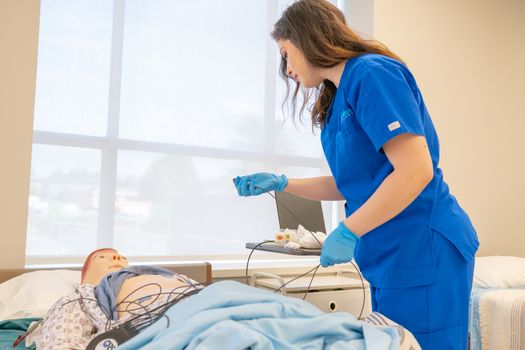
You have finished anatomy and physiology, your grades look respectable, and you are ready to apply—only to discover that your preferred nursing program requires another laboratory course, a different entrance exam, or prerequisite credits completed within a certain time frame. This is a common and preventable setback. Learning how to get into nursing school involves more than earning good grades. You also need to understand each program’s rules, prepare a complete application, and show that you are ready for demanding academic and clinical work.
Start by Choosing the Right Nursing Path
Before comparing schools, decide which type of nursing program fits your education, career goals, finances, and schedule. Common options include practical nursing programs, associate degree in nursing programs, traditional Bachelor of Science in Nursing programs, accelerated BSN programs for students who already hold a degree, and bridge programs for licensed nurses.
Do not assume that every program leads to the same credential or follows the same admissions process. Confirm the degree awarded, program accreditation, state approval, clinical placement structure, graduation outcomes, and eligibility requirements for nursing licensure. The American Association of Colleges of Nursing overview of baccalaureate education explains important features of undergraduate nursing education and admissions.
Compare Admission Requirements School by School
Nursing schools set their own standards. One may calculate a separate science GPA, while another may consider your overall GPA. Programs may also have different policies for repeated courses, transfer credits, online laboratories, entrance examinations, and prerequisite expiration dates.
Create a spreadsheet for every school you are considering. Include:
- Minimum overall and prerequisite GPAs
- Required science and general education courses
- Minimum grade accepted in each prerequisite
- Entrance exam requirements, such as the TEAS or HESI
- Application opening and closing dates
- Transcript and recommendation requirements
- Essay, interview, or healthcare experience requirements
- Policies for repeated, transferred, and online courses
Always check the current admissions page and contact the program directly when a rule is unclear. Meeting the published minimum may make you eligible to apply, but it does not guarantee admission to a competitive program.
Build a Strong Prerequisite Record
Courses commonly requested by nursing programs include anatomy and physiology, microbiology, chemistry, statistics, psychology, nutrition, and human development. The exact list varies, so complete only the courses that satisfy your target programs.
Science classes deserve special attention because they provide a foundation for understanding infection, medication effects, organ function, disease processes, and patient assessment. Instead of memorizing information for one exam, practice explaining concepts in your own words and connecting them to patient care.
If your schedule or location makes attendance difficult, carefully investigate whether your target schools accept remote coursework and laboratories. This guide to successfully completing nursing prerequisites online can help you develop a practical study plan. Obtain written confirmation from each nursing program before enrolling, especially if the course includes a virtual lab.
What if your grades are not competitive?
A weak semester does not automatically end your nursing plans. Review each school’s repeat policy before retaking a class. Some programs replace the original grade, while others average attempts or consider every grade earned. Focus first on required courses with low grades, particularly sciences, and avoid repeating classes without knowing how the new grade will be calculated.
Prepare for the Entrance Exam Strategically
If an entrance exam is required, begin with a diagnostic test rather than immediately rereading every textbook. The results can show whether you need the most help with mathematics, reading, language, science, or time management.
A better preparation routine includes short, regular study sessions, timed practice questions, and a written error log. For every missed question, identify whether the problem was missing knowledge, misreading, rushing, or poor calculation. Review the underlying concept before attempting similar questions.
Check the program’s testing rules, including minimum scores, accepted exam versions, waiting periods, attempt limits, and deadlines. Taking the exam too late can leave no time for a permitted retake.
Show That You Understand Nursing
Admissions committees want applicants who understand that nursing requires communication, sound judgment, emotional steadiness, teamwork, and attention to detail. Healthcare exposure may strengthen your application when it is accessible and relevant, but quality matters more than collecting random activities.
Possible experiences include volunteering in a hospital, hospice, community clinic, long-term care facility, or public health organization. Employment as a nursing assistant, medical assistant, emergency medical technician, or patient care technician may also provide useful insight. However, not every school requires healthcare experience, and applicants should not assume that a particular job guarantees acceptance.
Reflect on what you learned. A strong applicant can discuss patient dignity, confidentiality, cultural differences, teamwork, safety, and the limits of an unlicensed role without exaggerating responsibilities.
Write a Specific, Honest Personal Statement
A nursing school essay should explain why you want to become a nurse and what experiences prepared you for the profession. Avoid relying on broad statements such as “I enjoy helping people.” Instead, describe a meaningful situation, what you learned from it, and how it influenced your goals.
Answer the actual prompt. If the school asks about resilience, diversity, leadership, or an academic problem, address that topic directly. Use examples to demonstrate your qualities rather than simply listing them. Proofread carefully, follow the word limit, and ask a trusted reader to check whether the essay sounds like you.
Avoid Common Application Mistakes
- Applying only to one highly competitive program: Consider several schools that fit your goals, budget, location, and academic record.
- Assuming requirements are identical: Compare every prerequisite, exam, document, and deadline individually.
- Waiting to request records: Transcripts, recommendations, and test scores may take time to arrive and process.
- Choosing recommenders based only on job title: Select people who know your work, reliability, and readiness for nursing education.
- Submitting a generic essay: Tailor your response to the school’s prompt without copying marketing language from its website.
- Leaving sections incomplete: Review the entire application after uploading documents and confirm that all required materials were received.
- Ignoring professional communication: Use a suitable email address, check messages regularly, and respond politely and promptly.
Adopt Habits That Will Help After Admission
The habits that strengthen an application also make nursing school more manageable. Use a weekly calendar, begin assignments early, study actively, and seek help before you fall far behind. Practice retrieving information from memory, answering application-based questions, and teaching difficult material aloud instead of repeatedly highlighting notes.
Prepare for nonacademic clinical requirements as well. Depending on the school and clinical partners, admitted students may need a health evaluation, immunization or immunity records, tuberculosis screening, background checks, drug screening, CPR or Basic Life Support certification, and other documentation. Healthcare trainees may encounter infectious materials, which is why clinical sites often maintain health and safety requirements. Ask for the current checklist and allow enough time to complete multi-step requirements.
Use a Final Application Checklist
Several weeks before each deadline, confirm that your prerequisites, transcripts, exam scores, references, essays, and supplemental forms are complete. Keep copies of submitted materials and save confirmation emails. Continue monitoring the application portal because a submitted application may still be awaiting verification or supporting documents.
The best answer to how to get into nursing school is to work backward from each program’s requirements. Choose appropriate programs, protect your prerequisite GPA, prepare deliberately for any entrance exam, submit an accurate application, and demonstrate a realistic understanding of nursing. Thoughtful preparation cannot guarantee admission, but it can prevent avoidable mistakes and present your qualifications clearly.