
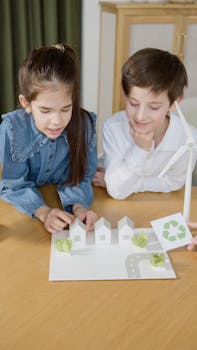
Creating a project for a science fair can be an exciting yet daunting task for young minds. When it comes to innovative and accessible projects, using cardboard can open doors to creativity and resourcefulness. Whether it’s creating a model of a scientific concept or conducting an experiment, cardboard provides a versatile medium that is both inexpensive and widely available. In this article, we will explore several cardboard science fair projects that are certain to engage and inspire students.
Why Choose Cardboard for Your Science Fair Project?
Cardboard is not only eco-friendly but also offers a simplicity that allows for complex ideas to be expressed in tangible form. The versatility of cardboard makes it an ideal material for various types of projects, from architectural models to functional scientific tools. Using cardboard can spark innovation and encourage students to think outside the box, leading to a myriad of creative possibilities.
Building a Cardboard Solar Oven
A solar oven is a fun and practical project idea that demonstrates the principles of solar energy. To create a solar oven, start by lining the inside of a cardboard box with aluminum foil to reflect sunlight. Use a black piece of paper as the base to absorb heat. Cut a flap on the box’s lid, cover it with plastic wrap or glass to trap heat, and angle it towards the sun. This experiment teaches students about renewable energy and environmental science.
Designing a Cardboard Bridge
This project challenges students to explore engineering concepts and structural integrity. Participants can experiment with different designs, including truss, beam, and suspension bridges using only cardboard and glue. Through this process, they will learn about the key principles of engineering, such as tension, compression, and load distribution.
Creating a Cardboard Marble Run
A cardboard marble run can illustrate the physics underpinning motion, gravity, and friction. By constructing a structure that directs a marble through various obstacles, students can observe the effects of gravity and speed, calculate the marble’s velocity, and alter the design to change its path. This project fosters problem-solving skills and encourages iterative design thinking.
Constructing a Cardboard Periscope
A cardboard periscope is an excellent way to understand the law of reflection. Using a few pieces of cardboard and strategically placed mirrors, students can create a periscope to see over obstacles or around corners. This project provides a hands-on experience with optical physics and introduces young students to the basics of light and reflection.
More Cardboard Science Fair Inspirations
Cardboard Volcano Eruption
Recreate the iconic volcano eruption using cardboard for the structure and a simple baking soda and vinegar mixture to simulate lava flow. This classic experiment allows students to explore chemical reactions and volcanology. It also encourages creativity in designing a realistic volcano model.
Constructing a Cardboard Anatomical Model
Students interested in biology can create an anatomical model using cardboard. This can range from a simple model of an animal cell to a complex representation of human organs. Such projects help in visualizing biological systems and understanding their functions in a tangible way. For students looking to integrate art into their science projects, they might explore opportunities described in scholarship programs for art students related to physiological illustrations.
Creating a Cardboard Circuit Maze
Introduce students to electricity and circuits by designing a cardboard maze that lights up when the correct path is chosen. Participants learn about electrical currents and circuit designs, which are fundamental concepts in physical science.
The Educational Impact of Cardboard Science Fair Projects
Cardboard science fair projects are not just about building physical models; they integrate a variety of educational principles. These projects enhance critical thinking, creativity, and practical problem-solving skills. They offer students the chance to make connections between theoretical knowledge and real-world applications. Moreover, the process of designing and executing these projects fosters perseverance and self-motivation.
Whether it’s through constructing a complex model or conducting an insightful experiment, participating in a cardboard science fair can ignite a passion for science and innovation. By pursuing projects that align with their interests and skill levels, students build confidence and gain a deeper understanding of the scientific process.
Cardboard Science Fair: A Medium for Creativity and Learning
A cardboard science fair offers a platform where imagination and science converge. Engaging with such projects not only raises awareness about sustainability but also cultivates a lifelong enthusiasm for learning and discovery. This hands-on approach encourages students to explore, experiment, and push the boundaries of their knowledge using simple materials.
In conclusion, embracing the cardboard science fair as a medium presents limitless opportunities for young innovators. It crafts an educational journey that emphasizes creativity, teamwork, and scientific inquiry. For more resources on supporting student projects and learning, visit Wikipedia’s education section.
- Cardboard projects are cost-effective and promote eco-friendly practices.
- They encourage innovation and problem-solving among students.
- Cardboard-based projects cover diverse scientific topics, from physics to biology.
- Participating in these projects can spark a lifelong interest in scientific endeavors.
- Cardboard science fairs foster an appreciation for the intersection of art and science.
Frequently Asked Questions
What makes cardboard a good material for science fair projects?
Cardboard is an excellent choice due to its affordability, ease of manipulation, and availability. It allows for creative expression and experimentation while being environmentally friendly.
How can cardboard projects be integrated with technology?
Cardboard projects can incorporate technology through simple circuits, coding exercises, and app-based enhancements, such as connecting models to sensors or online simulation tools.
Are cardboard science fair projects suitable for all age groups?
Yes, cardboard projects can be tailored to different age groups and educational levels. Simple models suit younger children, while more complex projects can challenge older students.
Can cardboard be used for long-lasting science fair projects?
While cardboard is not as durable as some materials, with proper care and additional reinforcements, it can be used for projects that withstand repeated use and demonstration.
Where can I find more ideas for cardboard science fair projects?
There are many resources online and in libraries. Collaborative forums and educational websites also provide inspiration and detailed guides for creating innovative cardboard science fair projects.

