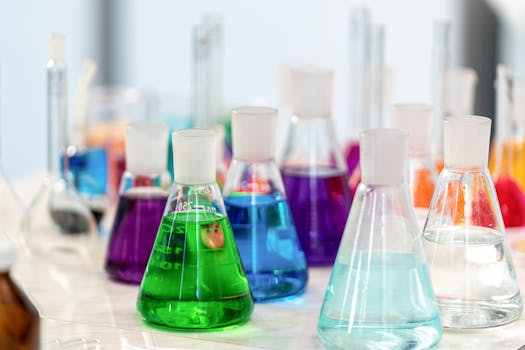
Chemicals projects can provide an exciting and engaging way for students and hobbyists to enhance their understanding and creativity in the field of science. These projects often involve experimenting with various substances and observing their reactions, which can spark curiosity and innovation. A well-designed chemicals project not only educates but also inspires learners to explore the scientific world beyond textbooks and classrooms. In this article, we will explore some innovative chemicals projects that are both educational and fun, catering to different interests and levels of expertise.
Innovative Chemicals Projects
Whether you’re a student looking to excel in your science class or a teacher aiming to make lessons more interactive, chemicals projects can be a perfect choice. Here are some creative projects that will help enhance learning and creativity:
1. Homemade Lava Lamp
This project is a wonderful way to explore concepts like density and polarity. Using simple household ingredients such as oil, water, food coloring, and effervescent tablets, you can create a captivating lava lamp. The oil and water will separate due to their different densities, and as the tablet fizzes, it will create bubbles of colored water that float through the oil. This visual experiment not only explains basic chemical principles but also captivates students of all ages.
2. Growing Crystals
Crystal growing is a fascinating project that demonstrates the process of crystallization and solubility. By dissolving a soluble substance such as sugar or salt in water and allowing it to evaporate, learners observe how crystals form over time. This project can be extended by experimenting with different substances or adding food coloring to watch how it affects crystal growth. For more in-depth learning, explore more scientific projects that provide a robust pathway to a career in science.
3. Creating a Chemical Volcano
A classic experiment, the chemical volcano is both dramatic and educational. By mixing baking soda and vinegar, learners can witness an exciting eruption. This project illustrates the concept of acid-base reactions, as the vinegar (an acid) reacts with the baking soda (a base) to produce carbon dioxide gas. This project also provides an opportunity to discuss reaction rates and how various factors can influence them.
4. Chromatography Art
Chromatography is a technique used to separate mixtures and can be beautifully transformed into an art project. Using coffee filters, water-soluble markers, and a bit of water, students can separate the colors in the ink to create unique designs. This project demonstrates the concept of solubility and the movement of solvents through a medium. It’s a brilliant way to introduce young learners to analytical chemistry while indulging their artistic side.
5. Designing pH Indicator Solutions
Understanding pH is fundamental in chemistry. By using red cabbage juice as a natural pH indicator, students can test the acidity or alkalinity of various household substances. The color change that results when the indicator reacts with an acid or base can range from deep red to bright green, providing a clear visual learn about neutralization reactions.
6. Exploring Non-Newtonian Fluids
This project involves making a non-Newtonian fluid like “Oobleck” using cornstarch and water. This fluid behaves differently under stress compared to ordinary liquids, offering a hands-on way to observe the physical properties of matter. Learners can experiment with how the fluid reacts to various pressures and forces, enhancing their understanding of material science.
Why Engage in Chemicals Projects?
Participating in chemicals projects offers numerous benefits, including the development of critical thinking and problem-solving skills. These projects encourage learners to ask questions, form hypotheses, and conduct experiments, thereby enhancing their cognitive abilities. Additionally, working on such projects helps build teamwork and communication skills, as many require collaboration and discussion.
Furthermore, chemicals projects align with various educational standards, helping educators deliver content that is relevant and tied to essential scientific concepts. By connecting theory to practice, students are more likely to retain information and develop an enduring interest in science.
Finally, these projects foster creativity. Science is not only about calculations and experiments; it also requires innovative thinking and creativity. By engaging in projects that encourage creative exploration, learners can nurture their imagination and discover new interests.
How to Get Started with Chemicals Projects
Start by selecting a project that matches your interest and skill level. Gather the necessary materials, which are often inexpensive and easily found at home or in stores. Ensure safety by using appropriate protective gear such as gloves and goggles. It’s crucial to follow all instructions precisely and ensure adult supervision for younger students.
Always seek to understand the science behind the experiment. Take notes on observations, results, and potential improvements for future endeavors. This reflection can help reinforce scientific concepts and inspire further exploration.
Conclusion: The Impact of Chemicals Projects
Chemicals projects can significantly contribute to education and personal development by promoting inquiry, innovation, and creativity. By immersing learners in hands-on experiments, these projects foster a deeper understanding of scientific principles. They offer a platform for curiosity-driven learning, encouraging students to explore and question the world around them. Embrace the challenge and joy of conducting chemicals projects to ignite a lifelong passion for science.
For further insights into educational projects, you can explore other scientific pathways like this educational resource that provides additional context and information.
- Chemicals projects enhance learning and creativity.
- They cover diverse scientific concepts like density, solubility, and reaction rates.
- Projects encourage critical thinking and problem-solving skills.
- Hands-on experiments nurture innovation and scientific curiosity.
FAQs
What are chemicals projects?
Chemicals projects are experimental activities that involve using chemical substances and reactions to learn about scientific principles and concepts.
Why are chemicals projects important in education?
They provide practical, hands-on learning experiences that help students understand complex theories and stimulate interest in science.
Are chemicals projects safe?
Yes, as long as safety guidelines are followed. It is important to use protective gear and work in a supervised environment, especially for younger individuals.
Can chemicals projects be done at home?
Many projects can be safely conducted at home using common household items, making science accessible to everyone.
What skills do chemicals projects develop?
These projects enhance critical thinking, creativity, problem-solving, and collaboration skills, providing a holistic educational experience.