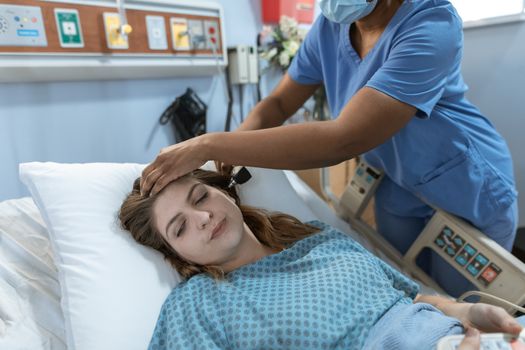
Imagine arriving for a nursing shift and knowing that, before it ends, you may help a family welcome a baby, respond to a rapidly changing emergency, or reassure a frightened patient through hours of labor. That combination of clinical responsibility and personal connection draws many nurses to labor and delivery. However, the work involves much more than being present at births. A labor & delivery registered nurse monitors two patients at once—the person giving birth and the baby—and must be prepared to act quickly when either patient’s condition changes.
What does a labor & delivery registered nurse do?
A labor & delivery registered nurse, often called an L&D nurse, provides care during late pregnancy, labor, birth, and the immediate recovery period. The nurse works with obstetricians, certified nurse-midwives, anesthesiology professionals, neonatal teams, and other clinicians.
Responsibilities vary according to hospital policy, state nursing regulations, and the patient’s condition, but commonly include:
- Evaluating patients who arrive with contractions, bleeding, ruptured membranes, pain, high blood pressure, or reduced fetal movement
- Checking maternal vital signs and assessing symptoms, medical history, and labor progress
- Monitoring the fetal heart rate and uterine contractions
- Starting intravenous lines and administering fluids and medications as ordered
- Supporting patients during induction, epidural placement, vaginal birth, or cesarean birth
- Providing breathing guidance, position changes, comfort measures, and emotional support
- Recognizing signs of complications such as hemorrhage, infection, hypertensive emergencies, or concerning fetal heart rate patterns
- Assessing the patient and newborn immediately after birth
- Teaching families about recovery, feeding, newborn care, and symptoms that require medical attention
Fetal monitoring is a particularly important skill. It may involve periodically listening to the fetal heartbeat or continuously recording the fetal heart rate and contractions electronically. The nurse evaluates the resulting pattern, documents changes, performs appropriate nursing interventions, and alerts the responsible clinician when necessary.
Education routes into labor and delivery nursing
Labor and delivery nursing is a specialty within registered nursing, not a separate entry-level license. A prospective nurse must first complete an approved nursing education program and qualify for RN licensure.
Associate Degree in Nursing
An Associate Degree in Nursing, or ADN, is commonly offered by community colleges and generally takes about two years after prerequisites, although the full timeline may be longer. It can provide a relatively affordable route to RN licensure. Some hospitals hire ADN-prepared nurses into labor and delivery, while others prefer a bachelor’s degree or expect employees to complete one later.
Bachelor of Science in Nursing
A traditional Bachelor of Science in Nursing, or BSN, usually requires about four years of full-time study. Its curriculum includes clinical nursing along with leadership, public health, research, and broader general education. A BSN may make an applicant more competitive for hospital positions and can support later advancement into management, education, or graduate nursing.
Accelerated and bridge programs
People who already hold a bachelor’s degree in another subject may qualify for an accelerated BSN program. These programs compress nursing instruction and clinical experiences into an intensive schedule. Licensed practical or vocational nurses may also enter LPN-to-RN or LPN-to-BSN programs.
An RN who initially earns an associate degree can later complete an RN-to-BSN program, often while working. Before choosing any route, students should confirm that the program satisfies licensure requirements in the state where they intend to practice, especially if the coursework is delivered online.
Licensure and specialty preparation
After completing an eligible nursing program, graduates apply to their state nursing regulatory body and register for the NCLEX-RN. They must receive authorization, pass the examination, and meet any other state requirements before practicing as an RN.
Some hospitals accept new graduates directly into labor and delivery residencies. Others seek applicants with prior experience in medical-surgical nursing, emergency care, postpartum nursing, or another acute-care area. A structured residency or extended unit orientation is valuable because new L&D nurses must learn fetal monitoring, obstetric medications, emergency procedures, newborn stabilization, and unit-specific protocols.
Employers commonly require Basic Life Support and may require training in neonatal resuscitation, advanced cardiac life support, or electronic fetal monitoring. Requirements differ among facilities. After gaining obstetric experience, nurses can pursue optional specialty credentials such as the RNC-OB certification in inpatient obstetric nursing. Certification does not replace an RN license, but it can demonstrate advanced specialty knowledge.
Where do labor and delivery nurses work?
Most L&D nurses work in hospitals that provide around-the-clock maternity services. A large medical center may separate obstetric triage, antepartum care, labor and delivery, operating rooms, recovery, postpartum care, and neonatal services into distinct units. In a smaller community hospital, one nurse may be cross-trained across several maternal-newborn areas.
Potential settings include:
- Community hospital labor and delivery units
- Academic medical centers and high-risk pregnancy units
- Obstetric triage departments
- Hospital operating rooms used for cesarean births
- Military and government medical facilities
- Travel nursing assignments in hospitals needing temporary staff
- Selected freestanding birth centers, depending on staffing models and state rules
This is usually shift-based work because labor cannot be scheduled around ordinary office hours. Nurses may work 12-hour shifts, nights, weekends, and holidays. Staffing needs, emergencies, documentation, or a delivery occurring near shift change can also extend the workday.
How much does an L&D registered nurse earn?
The federal government does not publish a separate national wage category specifically for labor and delivery nurses. They are included in the broader registered nurse occupation. According to U.S. Bureau of Labor Statistics pay data for registered nurses, the national median annual wage for RNs was $97,550 in May 2025. Registered nurses employed by hospitals had a median annual wage of $100,220.
An individual L&D nurse’s pay may be higher or lower based on:
- State and metropolitan area
- Years of nursing and obstetric experience
- ADN, BSN, or graduate education
- Specialty certification
- Hospital type and union agreements
- Night, weekend, holiday, or on-call differentials
- Overtime and travel assignments
When comparing job offers, consider health insurance, retirement contributions, paid leave, tuition assistance, scheduling rules, nurse-to-patient assignments, orientation length, and certification reimbursement—not salary alone.
Is labor and delivery nursing a good fit?
The specialty may suit nurses who communicate calmly, notice subtle clinical changes, and remain organized in unpredictable situations. It also requires physical stamina, comfort with blood and medical procedures, and the ability to move quickly from joyful moments to serious complications or pregnancy loss.
Labor and delivery nursing can lead to roles in charge nursing, clinical education, quality improvement, management, lactation support, or advanced practice. Nurses considering graduate education can also explore the differences between nurse practitioner and registered nurse career paths.
For many professionals, the appeal is the opportunity to combine technical nursing skills with advocacy and continuous bedside support. Choosing an approved education route, confirming state licensing requirements, and seeking strong obstetric training are the essential first steps toward becoming a labor & delivery registered nurse.