
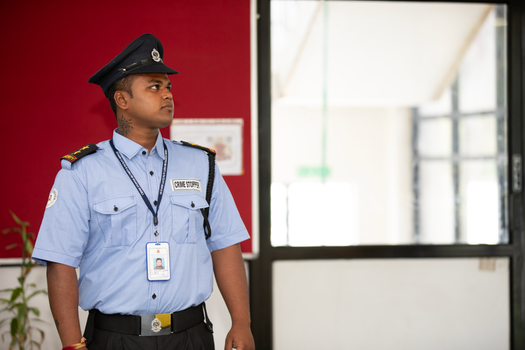
You arrive at an office building and notice a visitor arguing at the front desk while an alarm sounds in another part of the property. Who checks the situation, keeps people calm, follows emergency procedures, and documents what happened? In many workplaces, that responsibility belongs to a security guard. The job involves far more than standing at an entrance. It requires attention, sound judgment, professionalism, and the ability to respond appropriately when something seems wrong.
A clear security guard job description helps applicants understand the role and enables employers to attract dependable candidates. Although assignments vary by location, most security guards protect people, property, equipment, and information by preventing problems, monitoring activity, and responding to incidents.
What Does a Security Guard Do?
A security guard observes and protects a designated property, such as an office, hospital, school, apartment complex, retail store, warehouse, construction site, or event venue. Depending on the assignment, the guard may work at a fixed post, patrol on foot or in a vehicle, monitor surveillance cameras, or perform a combination of these tasks.
The central purpose of the position is prevention. A visible and alert guard may discourage theft, vandalism, trespassing, unsafe behavior, and violations of workplace rules. When an incident occurs, the guard follows the employer’s procedures, requests assistance when necessary, and creates an accurate report.
Security Guard Duties and Responsibilities
A security guard duty description should reflect the actual property and risks involved. However, the following responsibilities are common across many security positions:
- Patrol buildings, parking areas, grounds, and other assigned locations.
- Monitor entrances and verify the identity or credentials of employees, visitors, contractors, and delivery personnel.
- Operate security cameras, alarms, access-control systems, radios, and related equipment.
- Watch for theft, vandalism, fire hazards, suspicious behavior, and safety violations.
- Enforce property rules while treating employees, customers, and visitors respectfully.
- Respond to alarms, disturbances, medical situations, and other emergencies according to established procedures.
- Contact police, firefighters, emergency medical services, or supervisors when required.
- Conduct opening, closing, or lock-up checks for doors, windows, gates, and restricted areas.
- Direct visitors and provide basic information without revealing confidential security details.
- Prepare clear daily logs, incident reports, and written statements.
- Preserve incident scenes and relevant information until authorized personnel arrive.
- Report damaged equipment, lighting problems, blocked exits, and other potential hazards.
These security guard duties and responsibilities may change according to the assignment. A retail guard may focus on loss prevention and customer safety, while a warehouse guard may inspect vehicles and shipping documents. A hospital security officer may manage emotionally charged situations, whereas a residential guard may control entry and respond to resident concerns.
Essential Skills for Security Guards
Observation and concentration
Security work often involves long periods without an obvious incident. Guards must remain attentive instead of assuming that a quiet environment is automatically safe. Strong observation skills help them notice an unlocked door, an unfamiliar vehicle, unusual behavior, or a change in normal activity.
Communication
Guards communicate with visitors, employees, supervisors, emergency responders, and sometimes upset individuals. They need to give directions clearly, listen carefully, use radios properly, and provide accurate information. Written communication is equally important because reports may be reviewed by managers, insurers, investigators, or law enforcement personnel.
Judgment and problem-solving
Not every situation requires the same response. A guard must assess what is happening, follow procedures, and avoid escalating conflict unnecessarily. Good judgment includes recognizing personal limits and requesting assistance rather than taking unsafe or unauthorized action.
Professionalism and integrity
Security guards may have access to keys, private records, surveillance footage, restricted areas, or confidential information. Employers therefore look for honesty, reliability, discretion, and respect for privacy. Arriving on time and staying at the assigned post are also fundamental parts of dependable security work.
De-escalation and customer service
A guard may be the first person visitors meet, so the position often combines protection with customer service. Remaining calm, using respectful language, maintaining appropriate distance, and explaining rules clearly can help prevent disagreements from becoming more serious.
Physical readiness
Some assignments require extended standing, walking, stair climbing, or outdoor work in changing weather. Job postings should state the genuine physical requirements of the position, such as conducting patrols or responding promptly across a large property.
Education, Training, and Qualifications
Entry requirements depend on the employer, assignment, and state. Many employers prefer or require a high school diploma or equivalent. New guards commonly receive on-the-job instruction covering emergency procedures, communication, patrol methods, report writing, access control, and site-specific rules.
Licensing and registration requirements vary. Many states regulate security guards, and armed positions usually have additional requirements involving background screening, firearms permits, and specialized training. Applicants may also need to meet a minimum age requirement, pass a background check, hold a valid driver’s license, or complete drug screening. The U.S. Bureau of Labor Statistics profile for security guards provides an authoritative overview of typical education, training, licensing, duties, and working conditions.
Additional qualifications may include first aid and CPR training, previous military or public-safety experience, familiarity with surveillance technology, or experience in customer-facing work. These credentials can be valuable, but employers should separate true job requirements from qualifications that are merely preferred.
Typical Work Environment and Schedule
Security coverage is frequently needed outside standard business hours. Guards may work evenings, overnight shifts, weekends, holidays, or rotating schedules. Some positions involve working alone, while others are part of a larger team supervised from a control room.
The daily experience can differ significantly by location. A guard may spend much of a shift seated at a reception desk or watching multiple camera screens. Another may continuously patrol a large industrial property. Applicants should ask about shift length, indoor and outdoor duties, uniform requirements, supervision, break procedures, and whether the position is armed or unarmed.
Security Guard Job Description Example
A practical job posting might describe the position as follows:
The security guard protects employees, visitors, buildings, and property by monitoring activity, controlling access, conducting regular patrols, responding to alarms, and reporting safety or security concerns. The guard follows site procedures, communicates professionally with the public, contacts emergency services when necessary, and completes accurate incident reports. Candidates should be dependable, observant, calm under pressure, and able to work the assigned schedule. A high school diploma or equivalent and any license required by the state or assignment may be necessary.
Employers should customize this description with the work location, schedule, physical duties, required credentials, reporting structure, and equipment used. Specific details help candidates decide whether they can perform the role successfully.
How to Prepare for a Security Guard Application
Applicants should review the posting carefully and identify examples that demonstrate reliability, situational awareness, communication, conflict management, and rule enforcement. Experience from retail, hospitality, transportation, the military, customer service, or facilities work may be relevant even if the candidate has never held a security title.
A resume should use truthful, specific language. Instead of simply writing “watched the building,” an applicant might state that they monitored entrances, documented visitor activity, completed scheduled patrols, and reported safety concerns. Candidates who need help presenting transferable abilities can apply the same principles explained in this guide to writing a skills-focused resume for a responsible customer-facing role.
Is Security Work the Right Fit?
Security work may suit people who are dependable, observant, comfortable following procedures, and able to remain composed during uncertainty. It can be less suitable for someone who struggles with repetitive monitoring, irregular schedules, detailed documentation, or frequent interaction with the public.
The best security guards are not looking for confrontation. They focus on prevention, communication, and appropriate response. By understanding the complete security guard job description, applicants can evaluate the demands of the role, while employers can set realistic expectations and hire people prepared to protect the workplace professionally.

