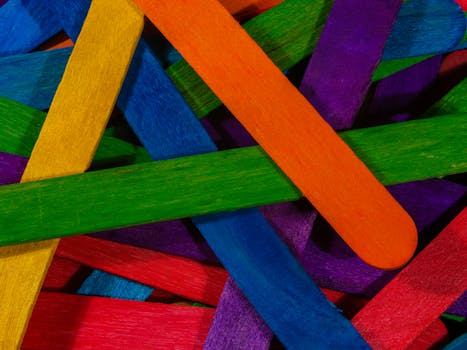
Welcome to the inspiring world of craft stick projects, where imagination meets learning in the most creative ways. Whether you’re a parent, teacher, or simply a craft enthusiast, craft stick projects offer endless possibilities for innovation and education. From constructing bridges for a science class to creating intricate artwork, these versatile tools can spark creativity while teaching valuable skills such as problem-solving and spatial awareness.
Getting Started with Craft Stick Projects
Beginning your journey with craft stick projects requires only a few basic materials, making it easily accessible for all ages and skill levels. With craft sticks, glue, paint, and an assortment of decorative items, you can create a wide array of projects that promote both fun and learning.
Craft sticks, often known as Popsicle sticks, can be transformed into educational tools or decorative items with just a little imagination. For instance, building small homes or structures can help children understand geometry and engineering principals. Moreover, these projects double as hands-on, kinesthetic learning experiences often valued in modern educational settings.
Craft Stick Projects: Educational Benefits and Ideas
Projects using craft sticks are not only entertaining but also educational, providing a platform to explore various learning domains. They encourage critical thinking, teamwork, and the development of fine motor skills.
1. Engineering and Architecture
One of the most practical uses for craft stick projects is building models that adhere to architectural principles. Crafting bridges or towers helps in understanding concepts like balance, weight distribution, and structural integrity. Engaging children in these projects can lead to an early interest in science and engineering fields.
2. Artistic Expression
For the artistically inclined, craft sticks serve as a blank canvas. From creating intricate wall hangings to crafting frames, the possibilities are endless. These projects can also be part of art programs that nurture creativity. For those considering art as a career, accessing scholarships for art students can be a great way to pursue formal education in the arts.
3. Mathematical Skills
Engaging with craft stick projects can help enhance mathematical skills. Designing geometric patterns or creating shapes encourages counting, measurement, and pattern recognition in a hands-on way that reinforces classroom learning.
4. Storytelling and Language
Craft sticks can also be turned into miniature characters or puppets, enabling storytelling activities that boost language skills and ignite imagination. These characters can prompt children to create their narratives, further improving their communication abilities.
5. Environmental Awareness
Teaching about recycling and sustainability can be seamlessly integrated into crafts by using repurposed or biodegradable materials. Building with craft sticks offers an excellent opportunity to discuss the importance of environmental care and conservation.
Tips for Successful Craft Stick Projects
To ensure that your craft stick projects are successful and enjoyable, consider the following tips:
- Keep materials organized to make the crafting process smoother and more efficient.
- Engage participants in the planning phase to boost involvement and investment in the project.
- Provide examples and templates to inspire creativity but also encourage original ideas.
- Use safe, non-toxic materials, especially when working with young children.
- Celebrate the completion of a project by displaying it, bolstering confidence and a sense of accomplishment.
Finding inspiration is easy with the vast resources available online. Websites, such as Wikipedia, offer additional information on incorporating educational elements into craft projects.
Craft stick projects offer a creative, educational, and engaging way to encourage learning and imagination in people of all ages. As you explore this craft, the possibilities for invention and discovery are infinite.
- Craft stick projects are versatile and educational.
- They can engage learners in engineering, art, and math.
- Crafts promote teamwork, creativity, and fine motor skills.
- Resources are accessible and eco-friendly projects are possible.
- Numerous online resources provide further inspiration and instruction.
FAQs
What age group is best suited for craft stick projects?
Craft stick projects are suitable for a broad age range. Young children can benefit from simple projects that improve motor skills, while teenagers and adults might tackle more complex designs involving architecture and art.
How can craft sticks be used in education?
Craft sticks can be utilized in educational settings to teach subjects such as geometry, engineering principles, and art. They offer a hands-on approach to learning, making abstract concepts more tangible and understandable.
What materials do I need to get started?
Basic materials include craft sticks, glue, scissors, and paint. Depending on the project complexity, additional items such as yarn, beads, or felt might be needed for decoration and assembly.
Are there eco-friendly options for craft stick projects?
Yes, eco-friendly options are available. Consider using sustainably sourced craft sticks, biodegradable materials for decorations, and repurposing old materials to minimize environmental impact.
Where can I find project ideas and templates?
Many resources are available online, from educational websites to comprehensive guides. Libraries and craft books can also be excellent sources of inspiration and detailed instructions.