
For a graduate student, few tasks feel as daunting as the first systematic review. Unlike a traditional essay, where you gather sources that support an argument, a systematic review asks you to find and assess all the relevant evidence on a question using a transparent, repeatable method. Done well, it becomes one of the most respected forms of academic work. Done carelessly, it collapses under its own gaps. This guide walks through the process step by step so you can approach it with a clear plan rather than a vague sense of dread.
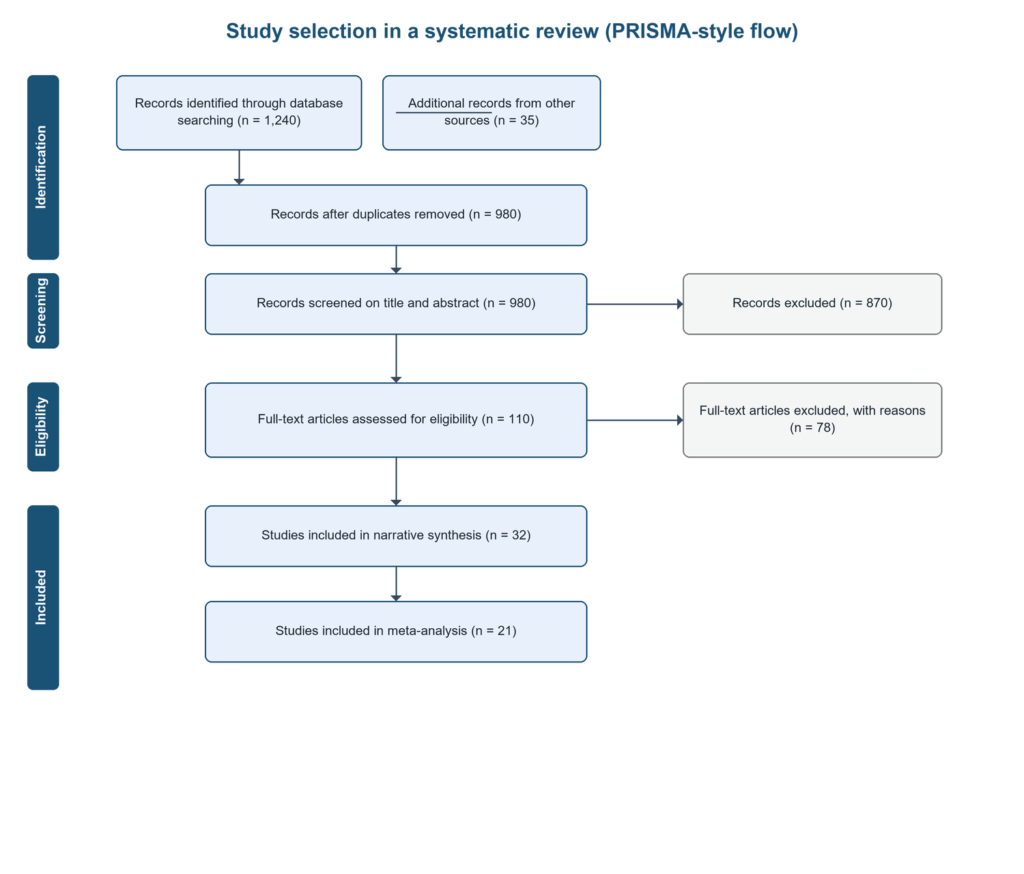
Figure: a PRISMA-style flow diagram tracks how thousands of search records are screened down to the final set of included studies.
Start with a focused question
Every strong review begins with a precise question. A vague prompt such as “does exercise help students” will bury you in thousands of unrelated results. A focused question names the population, the factor you are studying, any comparison, and the outcome you care about. The tighter the question, the more manageable every later step becomes. Spend real time here, because a sharp question is the single best predictor of a review that finishes on schedule.
Write a protocol before you search
Experienced researchers decide the rules before they look at the evidence, not after. A protocol records your question, your inclusion and exclusion criteria, the databases you will search, and how you will handle disagreements. Writing it down in advance protects you from the very human temptation to bend the rules once results start appearing. Many students register this protocol publicly, which signals rigor and guards against accusations of cherry-picking.
Build a search strategy you can defend
A systematic review is only as trustworthy as its search. That means moving beyond a single database and a few keywords. You will typically combine synonyms, subject headings, and Boolean logic across several databases, then record exactly what you searched and when. The goal is reproducibility: another researcher following your strategy should find the same studies. Keep a careful log of every query, because you will need it when you write up your methods.
Screen in two stages
Searches return far more results than you will keep, so screening happens in two passes. First you review titles and abstracts to discard the obviously irrelevant. Then you read the full text of the survivors against your criteria. Wherever possible, two reviewers screen independently and compare notes, because a second pair of eyes catches mistakes a single tired reader will miss. Record the number of studies removed at each stage, since you will need those numbers for your final flow diagram.
Extract data consistently
Once you have your final set of studies, you pull the same information from each one: study design, sample size, methods, results, and any limitations. A standard extraction form keeps this consistent and makes the next step, synthesis, far easier. Resist the urge to summarize from memory; structured extraction is what separates a systematic review from an ordinary literature summary.
Appraise the quality of each study
Not all evidence deserves equal weight. A large, well-controlled study tells you more than a small one with obvious flaws. Critical appraisal means judging the risk of bias in each included study using a recognized checklist, then carrying that judgment into how you interpret the findings. It is exacting work, and methodology specialists such as the team at researchgold.org spend much of their time here, because a review that treats a weak study and a strong one as equals is misleading, however thorough it looks.
Synthesize the findings
Synthesis is where the pieces come together. Sometimes the studies are similar enough to combine statistically in a meta-analysis. Often they are not, and a careful narrative synthesis is the honest choice. Either way, your job is to describe what the body of evidence shows as a whole, including where studies disagree and why. When a meta-analysis is appropriate, you can produce the summary figure with a forest plot generator rather than building it by hand, which saves time and reduces transcription errors.
Report transparently
The final write-up should let a reader retrace every step you took. Established reporting guidelines exist precisely so that systematic reviews stay transparent and comparable. Include your flow diagram, your appraisal results, and an honest discussion of the limitations in your own method. Reviewers trust work that admits its boundaries far more than work that claims to have none.
Avoid the pitfalls that slow reviews down
A few mistakes show up again and again, and each one costs time. The first is starting to search before the question and the inclusion criteria are settled, which forces you to backtrack and redo searches you thought were finished. The second is screening alone when a second reviewer could have helped, since a single reader quietly lets borderline studies slip through in both directions. The third is treating data extraction as casual note-taking rather than a structured task, so that two studies end up summarized in ways that cannot be compared. The fourth is confusing an ordinary literature review with a systematic one and skipping the steps, such as a documented protocol and a reproducible search, that give the method its authority. The fifth is leaving the write-up until the very end, when the reasoning behind early decisions has already faded from memory. None of these mistakes is fatal on its own, but together they explain why so many reviews stall for months longer than planned. Naming them before you start is the cheapest insurance you can buy, and a short checklist kept beside your desk often does the job.
A realistic word on time
A full systematic review is a marathon, not a weekend project. Most take months, and the screening stage in particular tends to swallow more hours than students expect. Plan for that, build in checkpoints, and lean on your supervisor early rather than late. If the process feels overwhelming, remember that the discipline the method demands is exactly what makes the result so credible, and credibility, in the end, is what a graduate researcher is working to earn.

