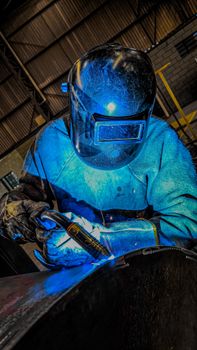
You may have heard that welding around ships pays well—or that underwater welders routinely earn six figures. Both claims can be true in certain situations, but they do not describe every job. So, how much does a marine welder make? In the United States, many marine welders earn roughly $40,000 to $80,000 per year, while experienced specialists, traveling workers, and commercial divers may earn more than $100,000. The actual figure depends heavily on what “marine welding” means in the job description.
Typical marine welder pay ranges
Marine welders build, maintain, and repair metal structures associated with ships, boats, docks, offshore facilities, and other waterfront equipment. Most work above water in shipyards or aboard vessels. A much smaller group performs underwater cutting and welding as part of commercial diving operations.
Federal wage data does not place every marine welder in one dedicated salary category. Instead, above-water workers are generally counted with other welders, while underwater welders are usually included with commercial divers. Based on May 2025 wage data, reasonable national benchmarks are:
- Entry-level or trainee marine welders: approximately $39,000 to $48,000 per year
- Established shipyard and vessel-repair welders: approximately $50,000 to $65,000
- Experienced structural, pipe, or traveling marine welders: approximately $65,000 to $90,000 or more
- Commercial divers, including some underwater welders: approximately $43,000 to $158,000 across the 10th-to-90th-percentile range
The U.S. Bureau of Labor Statistics wage profile for welders reports a median annual wage of $53,750, or $25.84 per hour, as of May 2025. The lowest 10 percent earned less than $39,240, while the highest 10 percent earned more than $77,530.
Commercial divers had a higher national median of approximately $72,990, or $35.09 per hour. However, commercial-diving figures cover many tasks besides welding, including inspection, salvage, rigging, construction, and equipment repair. They should not be interpreted as a guaranteed salary for someone completing an underwater-welding course.
Above-water and underwater welding are different careers
Shipyard and vessel welders
Most marine welders work in shipyards, fabrication shops, dry docks, or onboard vessels. They may join hull sections, repair decks, install bulkheads, or work on piping and machinery supports. Their earnings are generally comparable to those of other skilled structural and pipe welders.
These jobs may provide relatively steady schedules and employer-sponsored benefits. Earnings can rise when projects require night shifts, weekends, security clearances, travel, or extensive overtime. A worker earning $27 per hour has a straight-time annual equivalent of about $56,000, but overtime could raise total compensation significantly.
Underwater welders
Underwater welding is a commercial-diving specialty, not simply ordinary welding performed while wearing scuba equipment. Divers usually spend substantial time inspecting structures, setting up tools, cutting metal, assisting surface teams, and completing other construction or maintenance tasks.
The higher end of commercial-diver pay reflects specialized experience, difficult locations, union wage scales, offshore assignments, and hazardous conditions. Work can also be seasonal or project-based. Someone may earn a high weekly rate during an active assignment but have unpaid periods between projects, producing a lower annual income than the advertised rate suggests.
What changes a marine welder’s earnings?
Experience and demonstrated skill
New workers generally start as helpers, apprentices, tack welders, or entry-level production welders. Pay improves as they become faster and more consistent and can pass employer qualification tests in multiple positions. Welders who can interpret complex drawings, fit components, diagnose defects, and produce inspection-ready work are usually more valuable.
The welding process and material
Basic production welding may pay less than demanding pipe, structural, or repair work. Employers may offer higher rates for proficiency with processes such as shielded metal arc, gas metal arc, flux-cored arc, or gas tungsten arc welding. Experience with stainless steel, aluminum, and specialized alloys can also improve employment options.
Location and employer
Pay differs among coastal regions, ports, shipyards, government contractors, offshore companies, and small repair businesses. Major naval and commercial shipbuilding centers may provide higher wages or steadier employment than areas with limited marine activity. However, a larger paycheck in a high-cost port city may not provide greater purchasing power after housing and transportation expenses.
Overtime, shifts, and travel
Marine projects often operate under strict delivery schedules. Employers may need welders for long shifts, overnight work, weekends, or emergency repairs. Overtime can make up a large portion of annual earnings, but it is not always available.
Traveling welders may also receive per diem payments, lodging, transportation, or completion bonuses. Job advertisements sometimes combine these benefits with wages when describing earning potential, so applicants should ask which amounts are taxable pay and which are reimbursements.
Union membership and contract work
Union positions may offer negotiated hourly rates, scheduled raises, health coverage, retirement benefits, and overtime rules. Independent contractors can sometimes charge more per hour, but they may need to supply equipment, arrange insurance, pay self-employment taxes, and manage gaps between assignments. The highest hourly offer is not necessarily the best total compensation package.
Credentials and additional abilities
Training and certifications do not automatically guarantee higher pay, but they can help a welder qualify for more demanding positions. Employers may require workers to pass practical tests based on the material, process, and position used on a specific project. Skills in pipefitting, blueprint reading, rigging, inspection, or nondestructive testing can make a candidate more versatile.
Does the extra pay reflect harder working conditions?
Marine welding can be physically demanding. Shipyard welders may work in confined spaces, awkward positions, noisy environments, or changing weather. Welding operations can expose workers to hot metal, ultraviolet radiation, fumes, electrical hazards, and eye injuries. Proper ventilation, protective clothing, respiratory controls when required, and correctly selected eye and face protection are essential.
Commercial diving adds risks such as drowning, hypothermia, low visibility, heavy underwater equipment, and pressure-related illness. Safe diving depends on trained teams, reliable communication, carefully maintained equipment, and controlled depth and decompression procedures. These responsibilities help explain why advanced diving assignments may pay more, but workers should not choose the field based on dramatic salary claims alone.
Is marine welding a good financial career choice?
Marine welding can offer solid earnings without requiring a four-year degree. Technical school, an apprenticeship, military training, or employer-sponsored instruction may provide an entry route. Still, success depends on practical ability, safety awareness, reliability, and willingness to keep learning.
Students interested in ocean-related careers should also recognize that working around water can lead in very different directions. Welding is a hands-on skilled trade, while scientific careers usually involve different educational requirements. Comparing options such as whether college is necessary for marine biology can help clarify which path fits a person’s strengths and long-term goals.
The bottom line
For most workers asking how much does a marine welder make, a practical expectation is approximately $40,000 to $80,000 per year. Entry-level workers may earn less, while experienced pipe welders, travelers, union members, supervisors, and commercial divers may exceed that range. Six-figure earnings are possible, particularly with overtime or specialized diving work, but they are not automatic.
Before accepting a position, compare the base hourly rate, expected annual hours, overtime availability, benefits, per diem, travel requirements, safety practices, and likely time between projects. Those details provide a much more accurate picture of marine-welding income than an eye-catching advertised salary alone.