
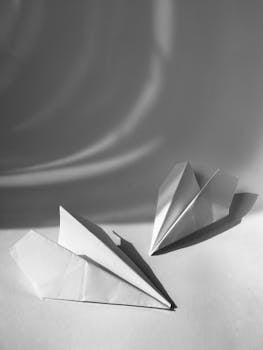
Paper airplanes have provided entertainment and exploration for people across the globe for centuries. The history of paper airplanes is intricate and surprisingly rich, stretching beyond the simplicity of their design. These small paper creations have marked themselves not just as toys, but as tools in instructional design, engineering trials, and a source of creative wonder throughout history.
The Historical Roots of Paper Airplanes
To trace the history of paper airplanes, one must journey back to the origins of paper itself. Paper was invented in China around 500 BCE, and it didn’t take long before the creative use of paper in various forms became apparent. Origami, the Japanese art of paper folding, has been closely linked to the development of paper aircraft. These early paper crafts were not designed to fly in the same way modern paper airplanes do, but they laid the groundwork for aerodynamic exploration.
By the time the Hans dynasty took an interest in kites, another aerial invention made from sheets of paper silk, the foundation for paper aviation was established. These early kites demonstrated basic principles of flight and lifted the imagination of those who sought to understand lift, drag, and aerodynamic potential.
The Ascendancy of the Paper Airplane
During the Renaissance, Leonardo da Vinci sketched ideas that resembled flying machines and experimented with paper models to understand aerodynamics better. However, it wasn’t until the 19th and 20th centuries that more recognizable paper airplanes began to take shape. The Wright brothers, noted for their pioneering aviation achievements, reportedly used paper models during their experiments.
In the 20th century, paper airplanes became popular thanks to increased access to inexpensive paper and developed folding techniques. The world saw a boom in the popularity of paper planes, with many aficionados designing new models and competing in distance and airtime challenges.
Today’s paper airplanes benefit from decades of aerodynamic research. Their designs range from simple to complex, involving intricate folds that demonstrate a sophisticated understanding of balance, lift, and propulsion.
Educational and Scientific Uses
Paper airplanes have found their way into educational settings, serving as accessible and interactive tools to teach students principles of physics and mathematics. Concepts such as gravity, thrust, and aerodynamic lift can be introduced and explored using a single sheet of paper.
Beyond classrooms, these paper models play a role in scientific experiments. NASA and other aeronautical organizations have used paper models to simulate and study the laws of aerodynamics. This tangible exploration helps bridge the gap between theoretical understanding and practical application.
The Cultural Phenomenon of Paper Airplanes
Globally, paper airplanes have left an indelible mark on culture. Competitions to achieve the longest flight or most accurate descent continue to captivate participants and spectators. In the digital age, their presence is noted in video games and software that simulate the thrill of launching a paper plane.
In particular, schools and organizations use paper airplanes in team-building exercises and creative workshops. This ability to captivate, educate, and challenge simultaneously underscores the cultural and educational relevance of paper airplanes even today.
To learn more about initiatives and projects that can inspire students, you might find our collection of recommendation letter examples useful.
The Future Potential of Paper Airplanes
While paper airplanes will always have historical significance, their future potential lies in innovation and sustainability. Research in biodegradable materials may influence future designs, making paper planes environmentally-friendly alternatives for creative expression and learning tools.
As technology evolves, so too does the interest in harnessing the principles paper planes illustrate. Engineers and hobbyists continually push the boundaries, integrating new technologies and materials into their designs.
The education role of paper airplanes suggests that their relevance will endure, leveraging simplicity to engage and educate about complex concepts.
The Timeless Appeal of Paper Airplanes
The history of paper airplanes is a celebration of curiosity blended with tradition. Whether used for education, competition, or leisure, paper airplanes bridge cultural and historical boundaries, making their mark on aviation, science, and arts. The enchanting journey of a paper airplane continues to soar in our imaginations, intertwining STEM learning with the simple joy of flight.
- Paper airplanes trace their origins over centuries, back to the invention of paper in China.
- They serve as educational tools for understanding basic principles of physics and aerodynamics.
- Modern paper airplanes benefit from advanced aerodynamics and folding techniques.
- Their cultural significance spans global competitions and creative activities.
- Future innovations might include sustainable materials for environmental benefits.
FAQ
What is the history of paper airplanes?
The history of paper airplanes dates back to ancient China with the invention of paper. Over centuries, these simple crafts have evolved and adapted, serving educational, recreational, and experimental purposes.
Were paper airplanes used by the Wright brothers?
Yes, the Wright brothers reportedly used paper models to explore and understand the principles of flight during their pioneering aviation work.
How are paper airplanes used in education today?
Paper airplanes are used to teach physics and engineering principles such as gravity, thrust, lift, and drag, offering a hands-on learning experience.
Are paper airplanes still relevant in the digital age?
Absolutely, paper airplanes continue to have cultural significance and remain popular for competitions, team-building activities, and educational purposes.
What might the future hold for paper airplanes?
Innovation in materials and design could lead to environmentally friendly models, and their educational role is likely to expand with new technologies.

