
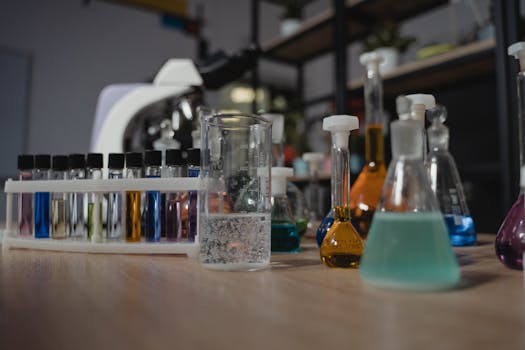
High school chemistry is a fascinating subject that provides students with an opportunity to explore the wonders of science through hands-on experimentation. Chemistry experiments for high schoolers are designed to enhance their understanding of chemical concepts while developing critical thinking and problem-solving skills. Whether it’s observing a chemical reaction or synthesizing compounds, these experiments bring textbook theories to life.
Engaging Chemistry Experiments for High Schoolers
To make high school chemistry exciting, it’s essential to integrate a variety of experiments that stimulate curiosity and encourage learning. Below are some engaging experiments that can be easily conducted in a classroom setting.
1. The Magic of the Baking Soda and Vinegar Reaction
This classic experiment demonstrates an acid-base reaction, showcasing how carbon dioxide gas is produced when baking soda (a base) reacts with vinegar (an acid). Students can measure the amounts of each reactant to balance the equation and guess the volume of gas produced. This experiment is an excellent way to introduce students to chemical reactions and stoichiometry.
2. Exploring the Slime Formation
By mixing polyvinyl alcohol with borate ion component found in certain laundry detergents or borax, students can create a polymer known as slime. This experiment helps in understanding polymers and cross-linking while exploring the properties of non-Newtonian fluids. It is a fun and educational way to grasp critical concepts in chemistry.
3. Investigating Electrochemical Cells
In this experiment, students can construct a simple electrochemical cell using household materials like pennies, aluminum foil, and vinegar. By doing so, they can learn about oxidation-reduction reactions, electricity generation, and the practical applications of batteries in everyday life.
4. Flame Test for Identifying Metals
The flame test introduces students to the concept of how different metal ions emit distinct colors when introduced to a flame. This experiment is visually appealing and provides insight into electron transitions and emission spectra, laying the groundwork for more advanced studies in atomic theory.
5. The Density Tower Challenge
Crafting a density tower with liquids like honey, water, oil, dish soap, and rubbing alcohol allows students to explore the concept of density. By layering different substances, students can understand why some liquids float on others and relate this to density and buoyancy principles.
Safety Considerations in Chemistry Experiments
Safety should always be a priority when performing chemistry experiments for high school students. Ensure that students wear appropriate safety gear, such as goggles and lab coats, and work under the supervision of an instructor. Always follow the lab’s safety guidelines to prevent accidents and ensure a safe learning environment.
For those interested in blending chemistry with other scientific disciplines, check out these free online courses in astrophysics and quantum science, which provide a broader perspective on science.
Additional Resources and Links
To explore more about educational methodologies and enhancements in learning science, visit this detailed article on education. It provides insights into various educational practices around the world.
As students engage with these chemistry experiments for high school, they build a robust foundation for future studies and develop a genuine appreciation for science. Bringing chemistry to life through experimentation not only enriches the learning process but also galvanizes students’ interest in pursuing scientific careers.
- Hands-on chemistry experiments are vital in high school education.
- Experimenting helps students understand theoretical chemistry concepts.
- Safety precautions are crucial for conducting experiments safely.
- Experiments can stimulate interest in science and future careers.
- Additional resources can further enhance learning experiences.
FAQ
What are the benefits of doing chemistry experiments in high school?
High school chemistry experiments offer hands-on learning experiences that help students understand theoretical concepts better. They also develop critical thinking, problem-solving, and analytical skills.
How can I encourage safety during chemistry experiments?
Encouraging safety involves ensuring students wear appropriate safety gear, follow lab safety rules, and conduct experiments under adult supervision. Providing safety training and clear instructions are also essential.
What is the importance of the flame test experiment?
The flame test is important for teaching students about emission spectra and electron transitions. It helps them identify metal ions based on the flame color emitted, providing practical insight into atomic structure.
How can density be demonstrated through simple experiments?
A simple density experiment involves creating a density tower using various liquids of different densities. Students can visually see why some liquids float on others and learn about density and buoyancy.
Which household items can be used for electrochemical experiments?
Simple electrochemical cells can be made using items like pennies, aluminum foil, and vinegar. These materials help demonstrate principles of oxidation-reduction reactions and electricity generation in an accessible way for students.

