
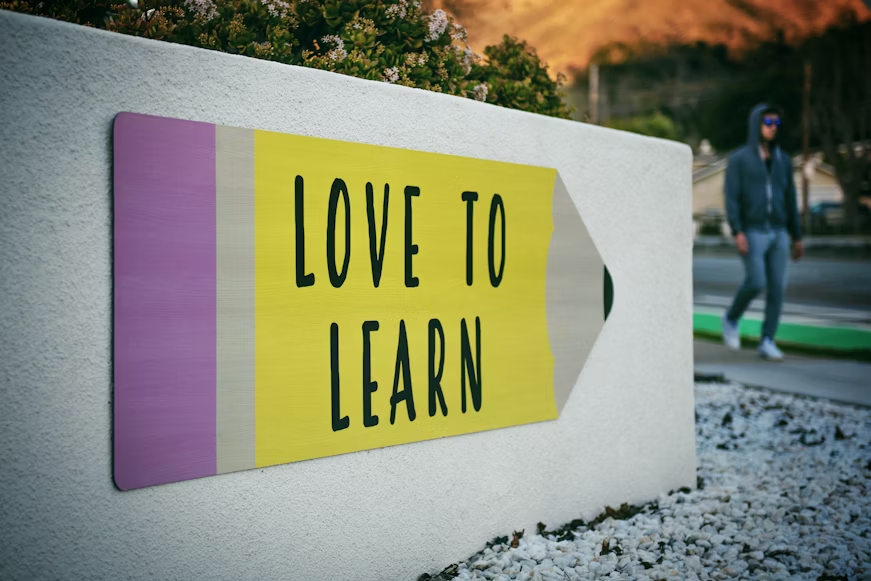
Inclusive education believes that every child, including those with unique needs, can learn. It acknowledges that each individual possesses distinct strengths, needs, and learning styles.
In the academic year of 2020/21, as reported by Statista, the United States had approximately 7.2 million children between the ages of 3 and 21 who were beneficiaries of the Individuals with Disabilities Education Act (IDEA).
In an educational setting that embraces diversity, all students, irrespective of their capabilities or any challenges they may face, learn in the same age-appropriate classroom.
Conventional educational approaches have often fallen short in fulfilling the educational needs of these learners, underscoring the importance of visionary leaders who understand the relevance and importance of inclusive programs.
This blog post will shed light on the role of new-age leaders in championing this transformative wave of education.
Why Is an Inclusive Model of Education Important?
It is a well-known fact that education is not a one-size-fits-all paradigm. Each student is unique and comes with their own needs. For some, textual instructions work like a charm, whereas for some, audio-visual means might work better. The teacher might need to resort to pizza slices to explain fractions to a group of kids, while others might make merry with simple oral instructions!
What if this idea gets extended to the realm of special children too? Why does it get so difficult for teachers to incorporate curated techniques for special children in everyday classrooms?
Children with special educational needs (SEN) have shown that they generally fare better in integrated classrooms as compared to segregated spaces. Moreover, being welcomed by their peers and faculty enhances their self-esteem.
When general education teachers co-teach with others, children with SEN can unearth skills and perceptions that might have been challenged in other classroom settings.
Inclusive classrooms also benefit typically developing students. These children, alongside their peers with special educational needs, develop a deep sense of respect, awareness, and acceptance of their classmates’ unique needs. They also display fewer prejudices and show a willingness to be helpful and empathetic toward their classmates.
Furthermore, inclusion can impact cognitive development, specifically concerning the theory of mind (ToM). The findings reveal that typically developing children, who get educated in classrooms alongside their peers with SEN, exhibit a more advanced development of ToM compared to their counterparts in traditional classrooms.
What Should New-Age Education Leaders Be Like?
A true leader needs to address modern-day issues and be mission-driven. It is imperative for visionaries who have set out to advocate for this comprehensive model of education to understand the inherent value of diversity. These leaders cannot get overwhelmed by the sheer magnanimity of diversity in society.
They should also have the mission to ensure that educators specializing in students with special needs are represented in the faculty. By doing so, they can foster an environment where students with exclusive needs can see themselves reflected in their teachers and feel a sense of belonging.
People in the position of making decisions on behalf of the institutions should be open to the idea of co-planning and co-teaching. According to this concept, segregated classrooms give way to common classrooms. Instructors for special education co-teach with other general education teachers, benefitting all students.
Teachers work together across all grades and students, with no distinction between ‘your’ child and ‘my’ child, but rather a unified sense of ‘our’ child.
But, in most cases, the stakeholders, like parents and teachers, do not have the necessary authority or power to bring about changes in inclusive education. It is generally the responsibility of people like the principal or the head of trustees to bring new organizational norms into practice.
If you believe in the cause and think you can become a leader, you can take up a doctorate degree in leadership and be a changemaker. The availability of the EdD program online makes it possible to pursue it without going back to formal settings.
It can equip you with the skills you need to make an impact in the field of inclusive education. According to Marymount University, the career options that can be pursued after an EdD degree include school principals, special education, nonprofit leaders, and business owners.
Strategies that Leaders Can Introduce to Bring About the Change
To be a visionary for new-age open-to-all classrooms means challenging the status quo and creatively presenting educational objectives in a way that captures everyone’s attention and provides equitable opportunities for all students.
Below are three important strategies that can be tried and implemented when designing an inclusive classroom and curriculum.
Universal Design Principles and Accessible Classrooms
UDL is a set of principles created to provide all students with equal access to learning opportunities. This is achieved by recognizing the individual learning styles of each person, which are supported by three primary brain networks – affective, recognition, and strategic.
The corresponding UDL Guidelines – Engagement( or the “why” for a concept), Representation( the essential “what”), and Action and Expression( the detailed “how”) – are used to enable interactive teaching strategies in classrooms.
By understanding the foundations of UDL, teachers can ensure that comprehensive learning is made possible for all students.
Assistive Technologies
Leveraging assistive technologies can help create a highly efficient learning environment for students. These tools, like text-to-speech software, speech recognition systems, and screen readers, go a long way in enabling students to learn and communicate effectively.
But in such scenarios, educators using these tools need to get trained and must stay informed about the technological developments of these tools. Moreover, even the students will need to get trained and guided to use them effectively.
Use of Augmented Reality and Virtual Reality
AR and VR technologies provide an innovative way to foster interactive learning experiences in the classroom. Through virtual simulations, 3D visualizations, and interactive learning experiences, students with mobility and sensory limitations can partake in activities that might otherwise be difficult.
AR and VR make the learning process immersive and participatory. By integrating these technologies into lessons, educators can create learning experiences that foster understanding, empathy, and active participation.
In Conclusion
A true leader with a mission to make integrated education mainstream will need to overhaul a lot of set procedures and arrangements. Not everyone will warm up to this idea at once. Persistence and staunch vision will be the key to making parents and educators believe in the novelty and effectiveness of this new wave of education.
Things might seem a little off and difficult for all the stakeholders in the beginning, but with time and conscious efforts of instructors and people in authority, these rough edges can get smoothened.
Science backs this mode of study, and with time, new and innovative procedures are bound to come into existence. So, the need of the hour is to have belief and patience.

