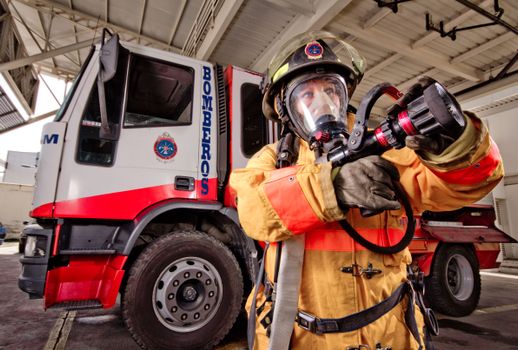
You may picture firefighters spending most of their shifts putting out building fires, but the job is much broader. Firefighters respond to medical emergencies, vehicle crashes, hazardous-material incidents, rescues and natural disasters. That means learning how to be a firefighter involves more than becoming physically strong: you must meet local qualifications, perform well during a competitive hiring process and prepare for demanding public-safety work.
What qualifications do you need to become a firefighter?
Requirements vary by department, so begin by reviewing the official job announcement for each agency where you intend to apply. In general, applicants must be at least 18 years old, hold a high school diploma or equivalent and have a valid driver’s license. Some departments also impose residency, citizenship or maximum-age requirements.
A college degree is not usually required for an entry-level position. However, courses or a degree in fire science, emergency management, public administration or a related subject may strengthen your preparation and support future promotion. The U.S. Bureau of Labor Statistics overview of firefighter careers confirms that firefighters typically need a high school diploma, emergency medical training and fire academy instruction.
Many departments require Emergency Medical Technician certification at the time of application, appointment or academy graduation. Some prefer or require paramedic credentials because a large portion of emergency calls involve sick or injured people rather than active fires. Check which certification level your target department accepts before paying for training.
Common eligibility requirements
- Minimum age specified by the department
- High school diploma, GED or approved equivalent
- Valid driver’s license and an acceptable driving record
- EMT or paramedic certification when required
- Legal authorization to work and any required residency status
- Ability to pass written, physical, medical and background evaluations
- Willingness to work nights, weekends, holidays and extended shifts
How do you become a firefighter?
For most municipal departments, the process begins with an online application or civil-service examination. Hiring can take several months or longer because departments may test large candidate pools and hire only when academy positions become available.
The typical process includes the following stages:
- Application review: The department verifies your education, age, certifications and other minimum qualifications.
- Written examination: Testing may cover reading comprehension, basic mathematics, mechanical reasoning, memory, judgment and interpreting maps or written instructions.
- Physical ability test: Candidates complete timed tasks that simulate essential fireground duties.
- Interview: A panel may evaluate communication, decision-making, motivation, teamwork and understanding of the profession.
- Background investigation: Investigators may review employment, education, references, criminal history, finances and driving records.
- Medical and psychological evaluations: These assessments determine whether a candidate can safely perform essential duties.
- Fire academy: Selected recruits receive classroom, practical and physical training before beginning probationary employment.
Not every department uses these steps in the same order. Some require a physical ability certificate before application, while others test candidates later. If you are also comparing firefighting with policing, corrections or investigative work, review these public-safety and criminal justice career opportunities.
What should you expect on the physical test?
Many departments use the Candidate Physical Ability Test, commonly called the CPAT, or a locally developed test. The CPAT includes eight events representing tasks such as climbing stairs, dragging a hose, carrying equipment, raising and extending a ladder, forcing entry, crawling through a search area, dragging a rescue mannequin and pulling down a ceiling.
Candidates perform the events while wearing a weighted vest, and the stair event adds extra weight to represent a hose bundle. The test measures work capacity rather than appearance or bodybuilding strength. You need enough cardiovascular endurance, grip strength, leg power, balance and muscular stamina to keep working safely while carrying equipment.
How to train safely
Begin well before your test date. Combine aerobic exercise with resistance training and task-specific practice. Walking stairs, step-ups, loaded carries, sled drags, rows, squats and controlled crawling can help prepare the movement patterns used during many physical tests. Increase duration and resistance gradually instead of attempting maximum effort immediately.
Protect recovery time, stay hydrated and practice good lifting technique. Avoid crash diets, dehydration strategies or unapproved performance-enhancing substances. If you have chest pain, fainting, unusual shortness of breath, an injury or a known heart, lung or metabolic condition, consult a qualified healthcare professional before starting vigorous training.
What happens during the medical evaluation?
Firefighting places substantial stress on the cardiovascular, respiratory and musculoskeletal systems. Protective clothing can retain heat, and self-contained breathing apparatus adds weight and breathing resistance. Candidates may also need to work in confined spaces, low visibility and extreme temperatures.
A department’s medical evaluation may assess vision, hearing, lung function, heart health, blood pressure, mobility and medical history. Drug and alcohol screening may also be required. A health condition does not necessarily produce the same decision in every department; the evaluating clinician considers the condition, its treatment and whether the applicant can safely perform essential job duties under the applicable standards.
Be accurate when completing medical forms. Concealing a diagnosis or medication can create safety concerns and may jeopardize employment. Applicants who need an accommodation should follow the department’s stated process rather than assuming they are automatically ineligible.
How can you prepare for the written test and interview?
Use the study guide issued by the testing agency because formats differ. Practice reading technical passages, performing calculations without advanced tools and following multistep instructions. Timed practice can reveal whether accuracy, pacing or test anxiety needs attention.
For interviews, learn about the department’s service area, call types and community programs. Prepare examples showing teamwork, integrity, conflict resolution, accountability and calm decision-making. Avoid presenting the job as an individual adventure. Departments need dependable team members who follow procedures, communicate clearly and treat patients and residents respectfully.
Your background packet deserves equal care. Collect employment dates, addresses, transcripts, driving information and references in advance. Minor past mistakes may not always be disqualifying, but omissions or conflicting answers can raise concerns about honesty.
Do you have to attend a fire academy first?
In some locations, the department hires recruits and pays them while they attend its academy. Elsewhere, applicants may complete a state-approved fire academy or obtain firefighter certifications independently before applying. Academy training commonly covers fire behavior, hoses, ladders, search and rescue, ventilation, hazardous materials, building construction, emergency medicine and protective equipment.
Another option is volunteering with a local department. Volunteer service can provide realistic experience with station responsibilities and emergency response, although it does not guarantee a paid position. Wildland firefighting offers a different route with its own fitness tests, seasonal hiring practices and specialized training.
Building a competitive application
If you are asking, “How can I become a firefighter when hiring is so competitive?” focus on qualifications you can control. Earn the required EMS credentials, maintain a responsible driving record, improve your fitness and develop a history of reliable work or community service. Practice communicating with people from different backgrounds and learn to accept coaching without becoming defensive.
The strongest candidates understand that firefighting is a service career built on preparation, trust and teamwork. Read each department’s requirements carefully, apply to more than one suitable agency and keep improving between hiring cycles. Persistence matters, but so does arriving medically, physically and professionally ready to do the job safely.