You notice that conversations sound muffled, the television volume keeps creeping up, or ringing in your ears makes it hard to concentrate. When you schedule a hearing test, the clinic lists your provider as “Dr. Smith, AuD.” That may leave you wondering: is an audiologist a doctor, and can this person provide the same care as a physician?
Is an audiologist a doctor?
Yes, many audiologists are doctors because they hold a doctoral degree—usually a Doctor of Audiology, or AuD. However, an audiologist is not a medical doctor or physician unless that individual has also earned an MD or DO degree.
The distinction matters. Audiologists are licensed health care professionals who specialize in hearing, balance, tinnitus, and related communication difficulties. They can identify and diagnose problems involving hearing or balance function, but they generally do not diagnose every underlying medical disease, prescribe medication, or perform surgery. Those responsibilities usually belong to physicians, particularly ear, nose, and throat specialists known as otolaryngologists or ENTs.
Why do audiologists use the title “doctor”?
Most people entering the profession in the United States now earn an AuD, a clinical doctorate designed specifically for audiology practice. After completing a bachelor’s degree, an AuD program typically requires about four years of graduate education. Training includes anatomy, physiology, acoustics, hearing and balance assessment, hearing technology, patient counseling, and extensive supervised clinical experience.
An audiologist with an accredited doctoral degree may appropriately use the title “Doctor.” To prevent confusion, the provider should also identify the profession—for example, “Dr. Lee, your audiologist”—rather than allowing patients to assume that the title means physician.
Not every practicing audiologist has an AuD. Some experienced professionals entered the field when a master’s degree was the standard and remain qualified under licensing rules. Others hold a PhD or another research-focused doctorate. If you are comparing health care career paths, it may help to understand how long different routes to becoming a doctor can take.
What can an audiologist do?
An audiologist’s work extends well beyond asking you to raise your hand when you hear a beep. Depending on the provider’s training, specialty, and state scope-of-practice rules, an audiologist may:
- Test hearing in infants, children, and adults.
- Determine the type and degree of hearing loss.
- Evaluate speech understanding, including hearing speech in background noise.
- Assess tinnitus, sound sensitivity, and some auditory processing concerns.
- Perform specialized tests of the inner ear, auditory nerves, and balance system.
- Recommend, fit, program, and verify hearing aids.
- Evaluate candidacy for cochlear implants and program the devices after surgery.
- Recommend assistive listening devices and hearing-protection strategies.
- Provide auditory rehabilitation and communication counseling.
- Refer patients for medical evaluation when test findings suggest a condition outside audiology’s scope.
These services can affect everyday life in practical ways. An audiologist may help you understand speech more clearly at work, participate in family conversations, manage listening fatigue, hear alarms, or use technology more effectively. The goal is not simply to make sounds louder; it is to improve useful hearing and communication while accounting for your needs, environment, and preferences.
What are the limits of an audiologist’s care?
The main tradeoff is specialization. An audiologist has deep expertise in hearing and balance function, but is not usually the professional who provides medication, surgery, or broad medical management.
When an audiologist may be the best first choice
Consider an audiologist when hearing difficulty has developed gradually, you struggle to understand speech, family members say you miss parts of conversations, you need a hearing-aid evaluation, or an existing device is not helping enough. Audiologists are also appropriate for many tinnitus, hearing-protection, cochlear-implant, and balance-testing needs.
A comprehensive audiologic evaluation can show whether hearing loss is present, which frequencies are affected, how well you understand speech, and whether the pattern suggests that medical follow-up is necessary.
When you may need a physician or ENT
An ENT is a physician who can evaluate diseases and structural problems affecting the ears and surrounding areas. ENTs can order medical imaging, prescribe drugs, and perform procedures or surgery. The National Institute on Deafness and Other Communication Disorders explains the roles of audiologists, ENTs, and other hearing-care professionals.
Seek immediate medical attention for hearing that disappears suddenly or declines rapidly over hours or a few days, especially when it affects one ear. Sudden sensorineural hearing loss is considered a medical emergency, and delaying treatment may reduce the likelihood of recovery. Significant ear pain, drainage, injury, or other acute symptoms may also warrant medical evaluation rather than waiting for a routine hearing-aid appointment.
In many cases, audiologists and ENTs work together. The audiologist measures hearing and balance function, while the ENT investigates and treats possible medical causes. Seeing both does not mean that one evaluation was unnecessary; each professional answers different clinical questions.
What happens at an audiology appointment?
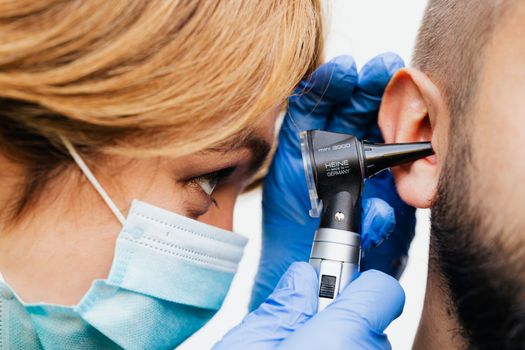
Your first visit will usually begin with questions about your symptoms, noise exposure, medications, medical history, and situations in which hearing is most difficult. The audiologist may examine your ear canals and perform several tests rather than relying on a single screening.
Afterward, the audiologist should explain the results in understandable terms. If hearing aids are appropriate, you may discuss styles, features, realistic expectations, follow-up care, and alternatives. A good appointment should not feel like a rushed product sale. The professional should connect any recommendation to your test results and personal communication goals.
How should you choose an audiologist?
Look for a professional who holds an active state license and has experience with your specific concern. Some audiologists focus on children, cochlear implants, workplace hearing conservation, tinnitus, or vestibular testing, while others provide general hearing care.
- Ask which degree and professional credentials the audiologist holds.
- Confirm that the clinic performs comprehensive diagnostic testing.
- Check whether the provider has experience with your age group or condition.
- Ask what follow-up services are included with hearing devices.
- Verify insurance coverage and whether your plan requires a referral.
- Expect a clear explanation of results, options, limitations, and costs.
The practical answer
So, is an audiologist a doctor? An audiologist with an AuD or another doctoral degree is a doctor of audiology, but not a physician. That distinction does not make the audiologist’s role less important; it defines the type of care the professional is trained to provide.
Choose an audiologist for specialized evaluation and nonmedical management of hearing and balance problems. Choose a physician or ENT when you need medical diagnosis, medication, surgery, or urgent treatment. For many patients, the best care comes from both professionals working together.