You may picture labor and delivery nursing as a specialty that requires its own college degree. In reality, there is no separate “labor and delivery nurse” degree. You first become a licensed registered nurse, then develop obstetric skills through clinical experience, hospital orientation, and specialty education.
For most students, labor and delivery nurse schooling takes about two to four years. An associate degree can provide a shorter route, while a traditional Bachelor of Science in Nursing generally takes four years. Prerequisite courses, licensing, job searches, and unit-based training may add time.
What degree does a labor and delivery nurse need?
Labor and delivery nurses are registered nurses who care for patients before, during, and immediately after childbirth. The minimum educational requirement is typically an approved registered nursing program leading to one of the following credentials:
- Associate Degree in Nursing, commonly called an ADN or ASN
- Bachelor of Science in Nursing, or BSN
- Diploma from an approved hospital-based nursing program, although these programs are less common
Graduates of these pathways may qualify for entry-level RN licensure. However, many hospitals prefer or require a BSN, particularly for highly competitive labor and delivery positions. A BSN also provides broader education in leadership, community health, research, communication, and care coordination.
You do not need a master’s or doctoral degree to work as a bedside labor and delivery RN. Graduate education is necessary if you later want to pursue certain advanced practice roles, such as nurse practitioner or certified nurse-midwife. Understanding the differences between a nurse practitioner and registered nurse career path can help you decide whether advanced practice fits your long-term goals.
How long does labor and delivery nurse schooling take?
Your timeline depends on your previous education and the program you choose.
Associate degree route
An ADN program usually includes approximately two years of nursing coursework. However, science prerequisites, competitive admissions, waitlists, and course scheduling can make the total process closer to three years for some students. This route may cost less than a four-year degree and can help you enter the RN workforce sooner.
Bachelor’s degree route
A traditional BSN program generally takes four years of full-time study. Students complete general education requirements, laboratory sciences, nursing courses, and supervised clinical rotations. Because hospitals may favor BSN-prepared applicants, this pathway can make it easier to compete for specialty positions after graduation.
Accelerated BSN route
If you already have a bachelor’s degree in another subject, an accelerated BSN may take approximately 12 to 18 months. These programs are academically demanding and often require students to complete specific science prerequisites before enrollment.
RN-to-BSN route
An ADN-prepared nurse can begin working as an RN and later complete an RN-to-BSN program. Depending on transfer credits and enrollment status, completion may take about one to two years. Some healthcare employers provide tuition assistance for this option.
After earning the degree, allow additional time to apply for licensure, take the NCLEX-RN, receive state approval, secure a position, and complete employer training. Overall, the journey may take roughly two and a half years on the fastest traditional route or four to five years when prerequisites and a BSN are included.
What will you study in nursing school?
Labor and delivery nurse schooling begins with general nursing preparation rather than focusing only on childbirth. Courses commonly cover:
- Anatomy and physiology
- Microbiology and chemistry
- Pharmacology
- Health assessment
- Medical-surgical nursing
- Mental health nursing
- Pediatric nursing
- Maternal and newborn nursing
- Nutrition, psychology, and statistics
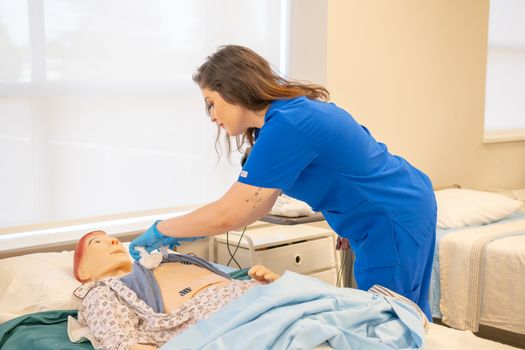
Approved programs also include supervised clinical experience. During a maternal-newborn rotation, students may observe or participate in prenatal assessment, labor support, postpartum care, breastfeeding education, and newborn assessment. Clinical placements vary, so graduating from nursing school does not always mean you will have extensive hands-on labor and delivery experience.
Licensing comes before specialization
After graduating from an approved program, you must apply to your state board of nursing and pass the NCLEX-RN. States may also require fingerprinting, a criminal background check, an application fee, and documentation from your nursing school.
Requirements differ by jurisdiction, so confirm that a program meets the rules in the state where you plan to work before enrolling. The U.S. Bureau of Labor Statistics overview of registered nurses explains the major education and licensing pathways for the profession.
How do new nurses train for labor and delivery?
Once licensed, an RN may apply directly to labor and delivery or first gain experience in postpartum, mother-baby, medical-surgical, emergency, or critical care nursing. Some hospitals hire new graduates into structured obstetric nurse residency programs, while others prefer candidates with previous bedside experience.
New labor and delivery nurses usually complete a unit orientation lasting several weeks to several months. They work with experienced preceptors while learning how to:
- Assess labor progress and maternal vital signs
- Interpret fetal heart rate and contraction patterns
- Administer medications and intravenous fluids safely
- Assist with inductions, vaginal births, and cesarean births
- Recognize obstetric emergencies
- Support patients through pain, anxiety, and unexpected changes
- Provide immediate postpartum and newborn care
- Document findings and communicate with the healthcare team
Depending on the employer, required training may include Basic Life Support, neonatal resuscitation, fetal monitoring education, and simulations for emergencies such as severe bleeding or maternal collapse.
Is specialty certification required?
Specialty certification is generally not necessary for an entry-level labor and delivery job. It becomes an option after you have gained substantial experience.
For example, the RNC-OB credential in inpatient obstetric nursing requires an active RN license, at least 24 months of specialty experience, a minimum of 2,000 specialty hours, and recent employment in the specialty. Certification does not replace state licensure, but it can demonstrate advanced knowledge and may support professional advancement.
How to choose the right nursing program
Before applying, make sure the nursing program is approved by the appropriate state nursing regulatory body. Ask about NCLEX preparation, graduation outcomes, clinical placement sites, total tuition, prerequisite requirements, and whether credits will transfer to a future BSN program.
If labor and delivery is your goal, look for schools with strong maternal-newborn coursework and clinical partnerships with hospitals that provide obstetric care. Even so, remain open to other first nursing jobs. Experience in postpartum, newborn, emergency, or general bedside care can build assessment, communication, and time-management skills that transfer well to labor and delivery.
What the career is like after training
Labor and delivery nursing combines routine care with rapidly changing situations. Nurses may spend one moment coaching a patient through contractions and the next helping a team respond to an emergency. Hospitals operate around the clock, so shifts may include nights, weekends, and holidays.
The most direct path is to complete an approved ADN or BSN program, pass the NCLEX-RN, obtain state licensure, and pursue obstetric training through an employer. Although the formal schooling usually takes two to four years, becoming confident in the specialty continues well beyond graduation through supervised practice, continuing education, and daily clinical experience.