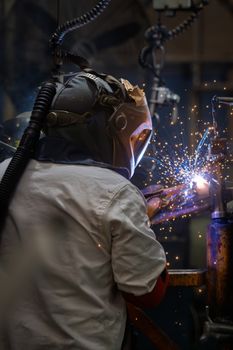
Imagine working in dark, cold water while wearing heavy gear, breathing through a supplied-air system, and handling equipment powerful enough to cut steel. It is reasonable to wonder whether one mistake could be fatal—and whether online claims about the underwater welding death rate are accurate.
Underwater welding is genuinely hazardous, but claims that 15% of underwater welders die on the job or that most do not live past age 40 are not supported by reliable occupational data. The best available statistics generally cover commercial divers as a group, not underwater welders specifically. That distinction matters because welding may be only one of many tasks a commercial diver performs.
What Is the Underwater Welding Fatality Rate?
There is no authoritative, current statistic that isolates the death rate for people actively performing underwater welding. Government records usually classify these workers as commercial divers, a category that also includes divers who inspect structures, recover equipment, repair pipelines, clear propellers, and perform construction work.
For context, NIOSH maritime fatality data for 2011–2017 reported an average commercial-diving fatality rate of 158.9 deaths per 100,000 workers per year. NIOSH cautioned that the rate might be inflated because the total workforce can be undercounted. The related federal data recorded 39 commercial-diving fatalities during that period.
These figures show that commercial diving has historically been a high-risk occupation. However, they should not be presented as a precise underwater welding death rate. They cover several years, include many kinds of diving work, and do not tell us whether welding caused each accident.
Why Online Death-Rate Claims Can Be Misleading
Some websites confuse annual risk with lifetime career risk. Others repeat statistics from earlier decades, when equipment, communications, training, and operating procedures were less advanced. A percentage may also come from a small group of offshore divers and then be incorrectly applied to every underwater welder.
Risk varies substantially by assignment. Welding in a controlled inland environment is different from repairing an offshore structure in strong currents, poor visibility, or deep water. Depth, water temperature, weather, equipment condition, employer practices, and emergency-response capability all influence the danger.
What Makes Underwater Welding Dangerous?
Drowning and loss of breathing gas
Drowning is one of the most serious risks in any commercial-diving operation. A damaged air hose, helmet problem, equipment malfunction, medical emergency, or loss of communication can leave a diver unable to breathe or return safely to the surface. Divers can also become tangled in cables, hoses, fishing line, structural components, or debris.
Water movement creates additional hazards. A pressure difference across a pipe opening, dam gate, intake, or damaged structure can pull and pin a diver against it. This pressure-differential hazard, often called delta-P, may be too powerful for the diver or surface team to overcome.
Decompression illness and pressure injuries
At depth, increased pressure causes more inert gas—usually nitrogen—to dissolve in body tissues. If pressure decreases too quickly during ascent, bubbles can form and produce decompression sickness. Symptoms can include joint pain, unusual fatigue, itching or mottled skin, dizziness, numbness, weakness, confusion, poor coordination, breathing difficulty, or paralysis.
A rapid ascent or breath-holding can also overexpand the lungs. Escaping gas may enter the bloodstream and cause an arterial gas embolism, potentially interrupting circulation to the brain, heart, or other organs. Both conditions can cause permanent disability or death and may require urgent hyperbaric treatment.
Electrical shock, burns, and explosions
Electricity can be used underwater when equipment and procedures are designed for the environment, but damaged insulation, incorrect grounding, or poor work practices can expose a diver to shock and burns. Even a nonfatal shock may cause muscle contraction, confusion, or loss of control that leads to drowning.
Welding and cutting can also create hydrogen and oxygen gases. If these gases collect inside a closed compartment, pipe, or overhead space, they may ignite or explode. The structure must therefore be evaluated and, when necessary, vented, flooded, or purged before hot work begins.
Cold, fatigue, and limited visibility
Cold water draws heat from the body and can contribute to hypothermia, reduced hand function, slower thinking, and poor decision-making. Heavy equipment and strenuous work increase physical fatigue. Darkness, sediment, noise, currents, and restricted movement make it harder to recognize or escape a developing emergency.
How Professional Dive Teams Reduce the Risk
Underwater welding should never be treated as solo work. In the United States, commercial-diving rules require trained team members, emergency planning, appropriate equipment, and communication procedures. Important protections include:
- A designated person in charge who understands the planned operation and its hazards.
- Continuous voice communication between a surface-supplied diver and the dive team.
- A tender who manages the diver’s hoses and cables and monitors changing conditions.
- A reserve breathing-gas supply and a clear method for recovering an injured diver.
- Depth-and-time monitoring, appropriate decompression tables, and controlled ascent procedures.
- A recompression chamber at the site when required by the depth, breathing mixture, or decompression profile.
- A surface-controlled welding switch that remains open except when the diver is actively welding or cutting.
- Proper grounding, insulated cables and connections, and insulated gloves.
- Inspection of pipes, compartments, intakes, electrical systems, and structural conditions before entering the water.
- First-aid and CPR training for dive-team members, with emergency contacts and transportation plans available.
A qualified diver also needs the authority to stop the job. Lost communications, unexpected currents, equipment problems, breathing-gas concerns, or a diver’s request to surface should trigger an immediate reassessment or termination of the dive.
When Post-Dive Symptoms Are an Emergency
Symptoms after a dive should not automatically be blamed on tired muscles or a difficult shift. New joint pain, numbness, weakness, dizziness, confusion, balance problems, chest pain, shortness of breath, an unusual skin pattern, or loss of consciousness requires urgent medical attention.
The team should activate emergency services, provide first aid and high-concentration oxygen if trained and equipped to do so, and arrange evaluation by professionals experienced in diving medicine. Symptoms can temporarily improve and then return, so improvement alone does not mean the danger has passed. Divers must also follow medical and operational guidance about flying or traveling to altitude after pressure exposure.
Does Underwater Welding Shorten Life Expectancy?
No dependable evidence establishes a specific underwater welder life expectancy or proves that the typical underwater welding lifespan ends at age 35 or 40. These numbers are widely repeated online without a credible population study behind them.
Career length is not the same as life expectancy. Some divers leave fieldwork relatively young because of travel demands, physical strain, family responsibilities, inconsistent assignments, or advancement into inspection, supervision, training, engineering support, or project management. Leaving underwater work at 35 does not mean dying at 35.
Long-term health depends on exposure history, fitness, medical conditions, previous diving injuries, noise, cold, workload, and adherence to safe decompression practices. Regular commercial-diving medical evaluations are important because heart, lung, ear, neurologic, and musculoskeletal problems may affect a diver’s ability to work safely.
Is the Risk Worth the Pay?
Compensation may be higher for specialized, remote, deep, or offshore assignments, but high advertised salaries are not guaranteed. Work can be seasonal, and beginners generally do not start with the most complex or best-paid projects. Anyone considering the field should compare training costs, working conditions, employment stability, and risk alongside the earning potential for underwater welders.
Underwater welding is dangerous, but it is not accurately described by sensational claims that every diver faces a fixed chance of dying young. The clearest conclusion is that commercial diving carries a substantially elevated occupational risk, while the precise underwater welding fatality rate remains unknown. Professional training, disciplined team operations, maintained equipment, conservative dive planning, and rapid medical response are what keep a demanding job from becoming an unnecessarily deadly one.