
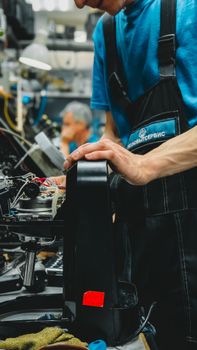
Your refrigerator stops cooling, and the repair technician finds the problem in minutes: a failed start component, not a ruined compressor. That kind of diagnosis may look effortless, but it depends on electrical knowledge, careful testing, mechanical skill, and experience. An appliance repair school helps students build those abilities in a structured setting before they begin working in customers’ homes.
Programs vary in length and depth, but most appliance repair training combines classroom instruction with laboratory practice. Students learn how household appliances operate, how to identify the actual cause of a failure, and how to complete repairs safely. Some programs also prepare students for industry credentials, entry-level employment, or further training in refrigeration and HVAC systems.
What Do You Learn in Appliance Repair School?
An appliance repair school typically covers major household equipment such as refrigerators, freezers, washing machines, dryers, dishwashers, ranges, ovens, and microwave ovens. Programs may also introduce garbage disposals, ice makers, compact appliances, and basic residential HVAC equipment.
The curriculum usually begins with fundamentals. Rather than memorizing a list of common failures, students learn how electricity, motors, pumps, valves, heating elements, controls, airflow, and refrigeration systems work together. This foundation allows a technician to diagnose unfamiliar models instead of replacing parts through trial and error.
Common Classroom Subjects
- Basic electricity, including voltage, current, resistance, circuits, and electrical safety
- Reading wiring diagrams, technical manuals, service bulletins, and parts diagrams
- Operation and testing of switches, relays, thermostats, sensors, motors, and control boards
- Water supply, drainage, pumps, hoses, valves, and leak diagnosis
- Gas and electric cooking equipment, ignition systems, and temperature controls
- Refrigeration principles, compressors, evaporators, condensers, and refrigerant flow
- Electronic controls, error codes, diagnostic modes, and connected-appliance technology
- Customer communication, repair estimates, service documentation, and parts ordering
Appliance repair is one of several skilled career paths taught through career and technical education. Readers comparing different options may benefit from understanding the broader definition and career purpose of trade school.
Hands-On Skills Matter as Much as Theory
Knowing what a motor does is different from determining why it will not start. Strong appliance repair training gives students repeated opportunities to inspect, disassemble, test, repair, and reassemble real equipment. Laboratory appliances may be intentionally given faults so students can practice following a logical diagnostic process.
A student might begin with a customer complaint such as “the dryer runs but does not heat.” The next step is not automatically replacing the heating element. The student must confirm the symptom, inspect airflow, review the wiring diagram, isolate the circuit, and test components. The cause could involve a thermal fuse, power-supply issue, damaged wire, restricted vent, control failure, or heating component.
Practical Abilities Developed in the Lab
- Using a digital multimeter to test voltage, resistance, and continuity
- Safely disconnecting power, water, gas, and other energy sources
- Removing panels and components without damaging wires, fasteners, or finishes
- Finding leaks, restrictions, worn parts, loose connections, and mechanical obstructions
- Testing components before deciding whether replacement is necessary
- Installing replacement parts and confirming that the appliance operates correctly
- Using diagnostic codes without treating them as automatic proof of a failed part
- Documenting findings, labor, parts, and completed safety checks
Some schools provide extensive sealed-system refrigeration practice, while others offer only an introduction. Students interested in refrigerator repair should ask whether the program includes refrigerant recovery equipment, leak detection, pressure measurements, brazing, evacuation, and charging procedures.
Safety Training Is a Core Part of the Curriculum
Household appliances can contain high voltage, hot surfaces, sharp metal edges, pressurized refrigerant, moving parts, gas connections, and components that store electrical energy after the appliance has been unplugged. Training should teach students to recognize these hazards before beginning a repair.
Safe procedures include confirming that equipment is de-energized, using properly rated test instruments, protecting against unexpected startup, checking for gas or water leaks, and following manufacturer instructions. Students should also learn when a repair falls outside their training or requires a licensed professional. Good technicians do not simply complete repairs; they know how to avoid creating electrical, fire, gas, water, or refrigerant hazards.
Which Credentials May Be Required?
A school certificate or diploma shows that a student completed a course, but it is not necessarily a government license. Requirements depend on the location, employer, appliances serviced, and type of work performed. Students should check state and local rules, especially if they plan to work with gas piping, electrical systems, or operate an independent business.
Refrigerant work has an important federal requirement. Technicians whose work may open a refrigerant circuit or release regulated refrigerants generally need certification under Section 608 of the Clean Air Act. The EPA recognizes Type I, Type II, Type III, and Universal certifications for different equipment categories. Type I applies to small appliances, while Universal covers all equipment types included in the program. The EPA explains the applicable tests and rules in its Section 608 technician certification requirements. This credential is earned by passing an EPA-approved examination and does not expire.
Schools may also offer preparation for voluntary credentials from industry organizations or appliance manufacturers. These can demonstrate additional knowledge, but employers may place equal or greater value on diagnostic ability, safe work habits, driving eligibility, customer service, and real-world experience.
How Long Does Appliance Repair Training Take?
Program length depends on the credential and schedule. A focused certificate may take several months, while a broader diploma or associate degree can take longer. Evening, weekend, hybrid, and accelerated options may be available, although online instruction cannot fully replace supervised practice with tools and appliances.
Students do not always need a college degree to enter the field. Some technicians begin with a high school diploma and employer-provided training. School can still be valuable because it provides organized instruction, access to equipment, guided troubleshooting practice, and a clearer understanding of safety before the student handles service calls independently.
How to Compare Appliance Repair Schools
Do not choose a program based only on its name or advertised completion time. Ask what students actually do in the laboratory and which credentials the tuition includes.
- How many hours are devoted to hands-on lab work?
- Do students practice on both older mechanical appliances and newer electronic models?
- Does the program teach diagnosis or mainly demonstrate part replacement?
- Are tools, textbooks, certification exams, and lab fees included in the stated cost?
- Do instructors have current field experience?
- Is Section 608 exam preparation available for students studying refrigeration?
- Does the school offer internships, apprenticeships, job-placement assistance, or employer partnerships?
- Can prospective students visit the lab and speak with recent graduates?
What Is the Work Like After Graduation?
Graduates may work for independent repair companies, manufacturers, retailers, property-management firms, warranty providers, or institutional maintenance departments. Others eventually become self-employed after gaining experience in diagnosis, scheduling, inventory, pricing, insurance, and customer service.
The job can involve driving between appointments, moving appliances, working in tight spaces, explaining repair options, and handling frustrated customers. Technical skill is essential, but reliability and communication also matter. A technician must translate a complex diagnosis into a clear recommendation and help the customer decide whether repair or replacement makes practical sense.
Is Appliance Repair School Worth It?
Appliance repair school may be a good fit for someone who enjoys solving practical problems, working with tools, and combining electrical and mechanical knowledge. The strongest programs do more than teach common fixes. They develop a repeatable diagnostic method, provide substantial hands-on practice, emphasize safety, and prepare students for relevant credentials.
Before enrolling, compare total cost, lab quality, curriculum, instructor experience, and local employment options. A well-chosen appliance repair training program can provide a useful entry point, but long-term success depends on continued learning. Appliance designs, electronic controls, refrigerants, and service procedures change, so capable technicians keep studying throughout their careers.

